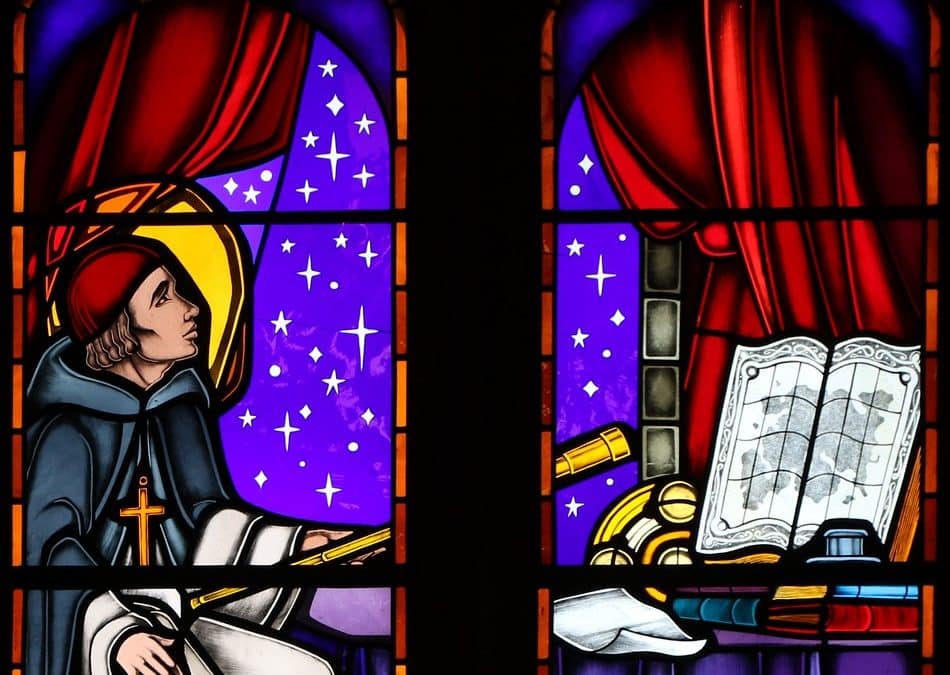


What does the rainbow have to do with the Catholic faith? Today, we find out from a medieval Dominican scientist named Theodoric of Freiburg. (Not to be confused with yesterday’s Theodoric.)
Born sometime before 1250, Theodoric was a German Dominican from the province of Teutonia. He originally belonged to the priory in Freiburg, of which he served as lector, caring for the friars’ intellectual formation. He continued his own studies at the University of Paris around 1275, earning the title Master of Theology. In 1293, he served a three-year term as Prior Provincial of Teutonia (the superior of the Dominicans in that region of Germany), a position that had also been held by St. Albert the Great. He died sometime after 1311.
Theodoric is best known for his advances in the science of optics. In 1304, while attending a General Chapter in Toulouse, he was approached by Aymeric, Master of the Order of Preachers, and was asked to write a treatise on the nature of the rainbow. One might very well question the prudence of this request. After all, why should a Dominican preacher, a professor of theology, be so interested in scientific endeavors rather than in the things of God? And why should the Master command that one of his theologians dedicate his time working on such a niche topic?
Theodoric himself gives the answer in the introduction to his treatise De iride et radialibus impressionibus (On the Rainbow and Radiant Impressions). It is fitting for him to write about the rainbow “so that, just as in the house of so great a patriarch solid food is not lacking for the perfect, so too those who are weak on account of age or more tender state may meanwhile eat vegetables” (De iride Prologue). Theodoric is speaking metaphorically here, drawing from the epistles of St. Paul (cf. 1 Cor 3:2, Rom 14:2). To put it more plainly, it is the responsibility of the Master of the Dominican Order to ensure appropriate intellectual training for all friars, not only those who are mature and ready for theology, but also those who are less advanced.
For Theodoric, the study of the natural world is not an obstacle to the study of theology. In fact, natural science can train and strengthen the mind, preparing it to delve into the divine mysteries. After all, theology is difficult! How can anyone be confident in thinking and reasoning about the transcendent and infinite God, unless he can first speak confidently about the things of his ordinary experience? So when we investigate the hidden causes of the physical world, we form habits of careful reasoning, which are essential for understanding the divine nature. This important insight reminds us that one truth is not completely separated from another, but they are all united in God as their ultimate source.
So what did this medieval friar discover about the rainbow? His contemporaries already knew that rainbows were produced by sunlight interacting with a cloud of water droplets in the sky. But there remained two largely unsolved questions: how the order of colors was produced and why rainbows were circular. One common opinion suggested that the colors were qualities of the four classical elements, layered within the cloud itself. The higher parts of the cloud were more fiery and therefore red, while the lower parts were more earthy and blue. When light was reflected off the cloud, a rainbow appeared, with red at the top and blue on the bottom.
Theodoric rejects this account altogether, for a host of reasons. First, the rainbow does not form a circle around the center of the earth, which is what we should expect if it were the result of elemental stratification. Second, clouds are irregularly shaped, while the rainbow is always a perfectly circular arc. Third, the rainbow moves with the observer, and not with the cloud. Fourth—and this is the real nail in the coffin—there sometimes appears a secondary rainbow, whose colors are exactly reversed: the blue appears above, while the red appears below.
The real answer, Theodoric deduces, lies in the role of each individual raindrop, and its position in relation to both the sun and the observer. Drawing from the findings of the Islamic scientist Alhazen, Theodoric describes the path of light in terms of the two operations of reflection and refraction. As a ray of sunlight hits a spherical drop of water at an angle, the difference in material causes the light to refract toward the center. This refraction both changes the direction of travel and weakens the clarity of light, thereby producing a variety of different colors. This ray is reflected on the opposite side of the droplet, and then refracted once again as it exits the droplet and travels toward the observer as colored light.
This geometric model explains many of the properties of the rainbow. Although each raindrop is too small to display the whole color spectrum, it can still radiate one color, as determined by the precise angle the drop makes between the sun and the observer. This in turn implies that each band of color must form part of a circle, whose center lies on the line from the sun to the observer. For this reason, the rainbow is largest when the sun is at the horizon, forming a full semicircle. In a brilliant stroke of synthesis, Theodoric shows that even the secondary rainbow is explained by a similar geometry. By being reflected not once but twice within a single droplet, light is emitted at a steeper angle and in reversed color order.

Diagram from a 14th century manuscript of De iride, modeling the path of the light ray that produces the secondary rainbow
Perhaps the most notable feature of Theodoric’s science was his method of experimentation. To supplement his theoretical reasoning, he reproduced the natural phenomenon of the rainbow in his own laboratory, using glass prisms and spherical flasks of water. Placing obstacles within the flasks, he was able to observe the exact trajectory and size of a light beam as it was refracted and reflected. Through these empirical observations, he could falsify rival theories while helping to support his own, in a strikingly similar manner to the modern scientific method. And all of this, over 300 years before Isaac Newton’s study of radiant color!
Theodoric of Freiburg is a prime example of the realism of medieval thought. He knew that science was neither vain speculation nor a distraction from the preaching vocation, but an exercise of the mind’s innate capacity to discover the truth. In his investigation of the rainbow, he strove for the perennial Dominican ideal of veritas, confident that it would always lead back to God the Creator.
✠
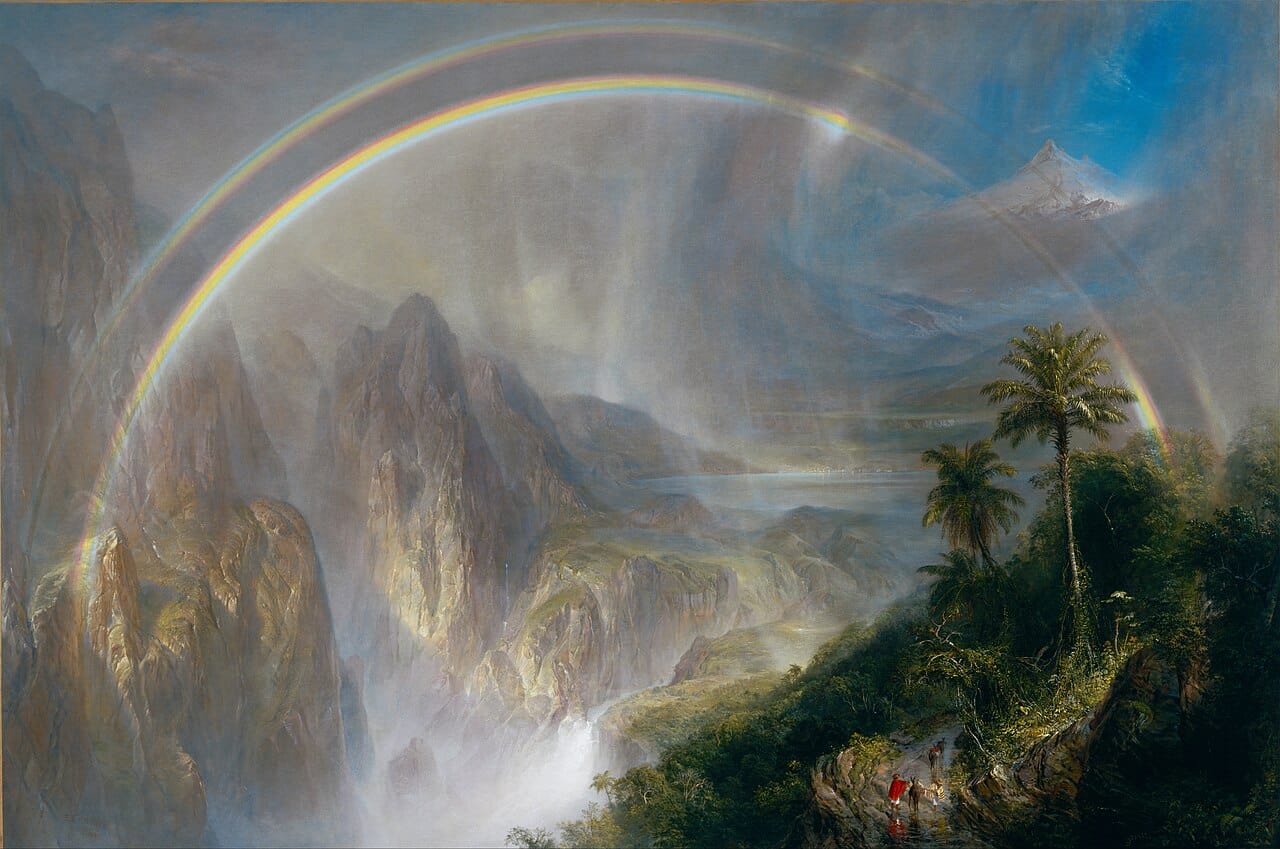
Header image: Frederic Edwin Church, Rainy Season in the Tropics, 1866
References:
Roudaut, Sylvain, Véronique Decaix, and Markus Führer, “Dietrich of Freiberg”, The Stanford Encyclopedia of Philosophy (Winter 2025 Edition), ed. Edward N. Zalta & Uri Nodelman, https://plato.stanford.edu/archives/win2025/entries/dietrich-freiberg/.
Theodoric of Freiburg. De iride et radialibus impressionibus. Edited by Joseph Würschmidt. Beiträge zur Geschichte der Philosophie des Mittelalters 12, nos. 5–6. Münster: Aschendorffsche Verlagsbuchhandlung, 1914.
Wallace, William. Scientific Methodology of Theodoric of Freiburg: A Case Study of the Relationship Between Science and Philosophy. Fribourg: University Press, 1959.