

In 1582, Pope Gregory XIII solemnly declared that October 4 that year would be followed not by October 5, but by October 15. Ten days were eliminated, just like that.
Why did he do this? The western world had been following the Julian calendar up to this point. But gradually, the Julian calendar had become misaligned with the heavens. 1600 years previous, Julius Caesar himself had implemented a calendar reform, resetting the date and adding leap years to account for the fact that the solar year is about a quarter of a day longer than 365 days. But not exactly a quarter. It’s a bit less: 365.2425 days. Which means that by 1582, the spring equinox—important for determining the date of Easter—came about eleven days too soon. To remedy this, the Gregorian Calendar was implemented: the date was reset to align with the heavens, and the policy of leap-years was modified such that at each year divisible by 100 (unless also divisible by 400) there would be no leap year. We keep these changes even to the present day. Key to this reform was a sixteenth century Dominican friar from Italy known as Ignazio Danti.
Danti was born in Perugia (a town north of Rome, near Siena) in 1536. He grew up in a family of artists and scholars. His father and grandfather were architects before him. They were also goldsmiths, sculptors, and published mathematicians. (In fact, their family name “Danti” was originally a nickname given to Ignazio’s grandfather on account of his talents.) Ignazio Danti’s brother was a local painter, and another brother was a sculptor. One of his aunts was a mathematician and a painter.
As a boy, Danti was trained in painting, architecture, and astronomy. He especially grew to love mathematics. When Danti was 18, he joined the Dominican Order. In his formation as a Dominican, he studied philosophy and theology. But following the trajectory of his upbringing, Danti made his career as a Dominican in the fields of math, architecture, cartography, and astronomy. He designed a monastic cloister, tutored noble children in mathematics, painted maps, and designed a huge terrestrial globe. He also published many astronomical treatises and manuals.
One of Danti’s most important contributions was the role he played in the Gregorian Calendar reform, which he undertook while in Tuscany. Using his various technical instruments and his mathematical expertise (part of the calculation process involved making a small hole in an upper round window, producing a camera obscura), Danti calculated that the Julian calendar had deviated from the true date by eleven days. On account of this, the Pope promoted him to serve on the commission for reforming the calendar. During this period, Danti enjoyed the title of Papal Cosmographer and Mathematician.
In 1583, Danti’s career took a new turn. In the past, Danti had been placed over a team of painters and engineers. Pope Gregory had apparently been impressed by his ability to lead, so he appointed Danti as Bishop of Alatria, where Danti served for the next three years before his death. While little is known of these years, it is said that Danti was a diligent Bishop, implementing reforms, convoking a diocesan synod, and even continuing some of his scholarly astronomical work. Danti died in Alatri in 1586, on October 10. He was fifty years old.
The information we have on Ignazio Danti’s life is limited. But what is clear is that Danti was prolific. He only lived fifty years. Within that relatively short life, Ignazio Danti . . .
. . . participated in the production of the ‘Hall of Maps’ in the Palazzo Vecchio.
. . . served as architect of a Dominican priory, the Complesso Monumentale di Santa Croce e Ognissanti, also known as ‘Santa Croce,’ in Florence.
. . . spent several years as a professor of mathematics and tutor to the sons of Cosimo de’ Medici, grand duke of Tuscany.
. . . helped to design the Navicelli Canal, joining Florence to the Mediterranean.
. . . designed a special window in the church of Santa Maria Novella allowing for a sunbeam to shine on the altar at noon.
. . . determined the exact degree of error of the Julian calendar and was a chief member of the commission which implemented the Gregorian Calendar.
. . . designed several astronomical devices and wrote manuals to explain their use.
. . . produced translations of several works, including some of Euclid’s lesser known books, such as the Optics.
. . . assembled a compendium of mathematical treatises (including essays written by his older brother).
. . . as bishop, instituted reforms in his diocese and convened a diocesan synod.
As we reflect on these many and varied projects, we can seek to emulate Ignazio Danti’s diligence. Clearly, Danti had an impressive career, engaging in a wide variety of projects and works. Of course, we could write this off by saying that he was naturally talented, that he was lucky to be given a good education, that he was surrounded by a family of talented and accomplished scholars and artists, or that he was supported by the Dominican Order which at that time was flourishing with great vitality. Danti was given a lot. But this fact should not overshadow the fact that Danti didn’t bury his talents. Rather he stewarded his gifts and training well, pouring himself into his many and varied works.
And so we can ask, why did he do all this? Because he admired his father and grandfather and wanted to follow their footsteps and live up to the family name? Probably. Or was it because Danti loved science, and enjoyed the process of probing for the hidden truths of the created universe? Definitely. But in interpreting his life, we have to be open to an additional reason, a further and deeper sense of purpose which may have motivated Danti to live out such a career as a Dominican, and eventually as a bishop: deep down, Danti loved God. That his relentless drive to seek out the order of the universe through his astronomy and mathematics and then to instantiate this order in his teaching and architectural work were motivated ultimately in the love of God. That it wasn’t just a love of planets that aroused him, but instead, like his namesake, Ignazio Danti’s “desire and will were moved by the Love that moves the sun and the other stars” (Paradiso 33.143–145).
✠
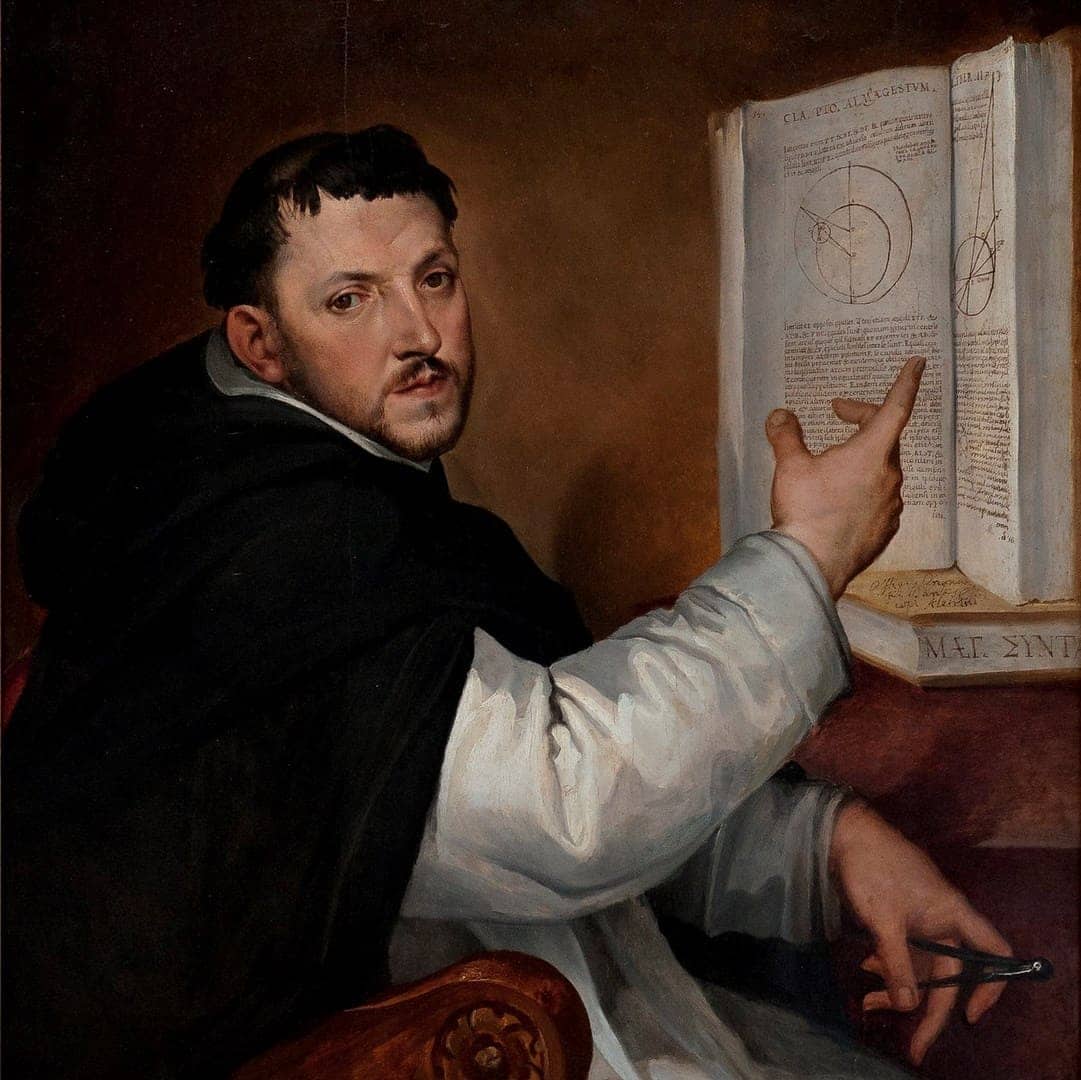
Image: Bartolomeo Passarotti, Portrait of Ignazio Danti