

Today, we rewind 70 years to present an essay by Br. Basil Boyd, O.P., who wrote this essay for the 1956 autumn edition of Dominicana.
✠
The “Plight of the Intellectual” has occupied a prominent place in the scholarly and serious forums of contemporary society. Echoed in the periodical press, this discussion has impressed itself upon the attentions of all. There are indeed indications that our society is at last ready to accept scholars and intellectuals in their proper role; nonetheless, a vociferous party continues to demur and accuse and some among the intellectuals themselves profess naught but pessimism and disillusion.
Within the Church, where the works of the mind are traditionally cultivated and valued, such leading thinkers as Fr. John Tracy Ellis and Bishop Wright of Worcester have felt constrained to speak out for the rights of the intellectual lift within the framework of American Catholicism. The Church in this country, they rightly point out, has definitely emerged from the frontier conditions of the last century. Now is the time to bring to flower those distinctive element of Catholic culture for which the seed was laid in the very beginning. Now is the time to give the lie to those who rebuke the Faith as intellectually sterile and stifling. Now is the time to reassert that leadership in the empires of the mind which goes back through Aquinas and Augustine to the very Word-made-flesh whose Church is founded in the truth of doctrine and who left us the command: “Going therefore, teach ye all nations.”
Yet how are Catholic scholars to break forth from that intellectual cocoon, that intellectual apartheid, to which they often seem relegated? How are we to gain that respect which will give weight to our teachings? Or rather, whence shall we deprive that integrity and strength of intellect whose intrinsic appeal will argue its own case both before the bar of secular scholarship and before the people as a whole? The present article attempts to answer this question. In their penetrating studies, Bishop Wright, Fr. Ellis and their fellows have shown us the what and why of Catholic intellectual activity. We believe that Saint Thomas, in the moral section of his Summa Theologiae, has a very illuminating study of the how of the intellectual life, and we here undertake an application of his teaching to the contemporary question. First, backtracking to re-examine certain reactions towards intellectualism, we will go on to show that the tensions arising from the more extreme reactions are eased by a special virtue, to wit, the virtue of studiosity. For a better understanding, this will be contrasted with the characteristic operations of the contrary vice of curiosity. We firmly believe that the Thomistic exposition of this virtue will help all students, whether secular or explicitly Catholic, to strengthen and rejuvenate their habits of study and thought.
There are two positions current with regard to the intellectual life. One asserts the complete independence and self-justification of the pursuit of knowledge; the other favors the subordination of speculation to the study of practical and even military projects. Both views have been put forth persuasively by professed scholars and thinkers. Yet the adherents of the former frequently seem to divorce the life of study from any sense of limitation and from any responsibility to other human and social values. These excesses, strongly fixed upon by the popular mind, have characterized that mind’s concept of “ivory-towerism.” The common man sees the absent-minded professor, the cold, abstracted philosopher, and the dreamy, undisciplined Bohemian as disparate symbols practically expressing this strange, useless and unjustifiable life of sheer thought and study. Nor have there been theorists lacking to vocalize this popular reaction; yet these have too often sinned, on the other hand, by denying any validity to the intellectual life unless it bear fruit in tangible material benefits to the community. Too often the scientist, the nuclear physicist or electronics engineer, are made the exclusive symbols of successful, practical intellectual achievement.
Between these excessive, imperfect, and typically vicious reactions to the life of thought and study, there mediates a moral virtue. That virtue is the virtue of studiosity, discussed by Saint Thomas in Q. 166 of the Secunda Secundae.
At first we may be somewhat surprised at what Saint Thomas sets down as the nature of studiosity. If we think of the studious person as being the “bookish” fellow who has ransacked the shelves of every library in town, or the curious one who is ever delving into new fields or pressing new frontiers of knowledge, we are wrong. One needs no special virtue to supply the drive for such intellectual adventures; our very nature impells us to seek to know everything about everything. Anima est potentia omnia, Aristotle taught: the soul, by knowledge, can become ALL THINGS and one of the strongest drives in our nature is to fill this potency, to achieve this mastery. With eyes and ears constantly open for any stray bit of information that may prove helpful or interesting, we strive to satiate this hunger not only in school and formal study, but at every moment of the day. The press, radio, and television all capitalize on this passion for facts, for news. An exciting or tragic event such as the collision of the Stockholm and Andrea Doria this past summer can district the attentions of half the world for days, so strong is our passion to know. By his very nature, then, man has a boundless desire for knowledge—a desire so overpowering as to be at times unreasonable and immoral. To regulate this desire, and bring it into harmony with the other necessities of life, is the task of the virtue of studiosity.
For studiosity is a part of the virtue of temperance, to which it pertains to moderate the attractions of the appetite, lest it tend too much towards that which nature desires. Negatively, its task is to moderate, to restrain that eagerness to know which is a part of human nature. Positively conceived, the role of studiosity is to apply and direct our intellectual activity to its proper end. It is a channel, containing as it were the surging waters of mental power, preserving them from dissipation and consequent shallowness. It is the channel wherein the currents of the mind rush on in great depth and due force to engulf their object.
We should not imagine, however, that studiosity accomplishes these great feats autonomously, and without reference to the rest of life. Studiosity in itself is a lesser, limited virtue. In attaining the stature of perfect virtue, this lesser virtue must be connected and harmonized with all the others towards the proper direction of human life. Now this doctrine of the connection of the virtues shows the special value of studiosity to the scholar and intellectual. For if his principal activity is virtuous, if he restrains from what is unjustified or wasteful or misleading in the life of study, and if he directs his study towards proper ends, this will ensure the goodness of his entire life. On the other hand, he cannot hope to reap the fruits of studiosity if he is infected with some other vice—for experience has shown that intemperance, pride, and especially lust will frustrate and vitiate that good use of even the greatest natural talents. If he finds no satisfaction in his knowledge, no peace in the truth, let him check to see if some ugly habit has not destroyed that balance in his life which would allow the virtue of studiosity to channel his mental activities to their proper end.
The end or purpose of human activity is paramount, for the end is said to specify or determine the moral character of an action. Thus a human action such as study will be good only if the end or object of study is good and legitimate. Now the object is good if it is in agreement with the dictates of right reason and the eternal law of God.
The end of all human life, determined by God’s law and apprehended by right reason, is God himself. Man’s ultimate happiness is the knowledge of God: “This is eternal life, that they may know Thee, the one true God . . .” (John 17:3) Ultimately, then, God is the end and meaning of all human life, just as He is the maker and principle of all. All human activity leads either to him or away from Him. Knowledge and study must lead to God. It must find God’s truth in all reality. In all practice, in all application, our study must be directed towards God.
The delights and privileges of the intellectual life are justified and sanctified if they are directed towards God. The leisure and seclusion of the scholar, seemingly fruitless in the material and secular frame of values, are of the highest value when they lead to God. Nor is this true only when study results in some direct proof or revelation of divinity—the very least appreciation of truth, beauty, and order in the universe is an apprehension of God. The recognition and contemplation of God’s presence in the world, generating a corresponding love of His goodness and magnificence, is analogous with the life of heaven, even on the purely natural plane. Divine charity, too, can motivate the work of the applied scientist, exploiting the conclusions of research for the welfare, protection, and ennoblement of the human person and of society.
The scope of truly virtuous study may be seen more clearly by contrasting it with certain vicious tendencies in the desire for knowledge. The desire of knowledge to inflate pride—that devil which waylays all promising intellectual pursuits—or for the prosecution of some sinful act, is obviously ill-inspired. But even the very desire of knowledge for its own sake might be vicious, and we must watch lest our eagerness to learn be inordinate and improper. How often does the study of something less than useful distract us from those studies which are necessary or obligatory? Too much time spent with what is ephemeral or merely amusing will hardly leave us opportunity for great intellectual achievements. Or think how we itch at times to seek out the opinions of some pagan and immoral philosopher, of some insidious book, spurning at the same time the solid and proven sources of truth, and even refusing to look objectively at the world about us. Again, one’s intellectual life might be rendered fragmentary and meaningless, by failure to synthesize what is learned into a deep wisdom that sees all things in hierarchial subordination to God. Lastly, many expend their efforts in vain scrutiny of mysteries that cannot be unravelled, of intuitions and certitudes far beyond their proper powers. In short, how many are seduced by the vice of curiosity to dissipate and exhaust their talents of mind, in violation of that wise counsel of the Holy Spirit; “Seek not the things that are above thee, and search not into things above thy ability: but the things that God hath commanded thee, think on them always. In unnecessary things be not over curious: and in many of His works thou shalt not be inquisitive . . . . For the suspicion of them hath deceived many, and hath detained their minds in vanity” (Eccl 3:22-26).
The misery that has entered the world through the vice of Pandora, curiosity, can hardly be fathomed. For while choice and action depend on the will, that blind faculty must be led by the intellect. How often in human experience have minds of great power and penetration, enflamed by curiosity and ultimately by intellectual pride, led individuals and whole nations into stupidity, confusion, and utter ruin. The intellectual life can never be justified when it does not rise above the level of self-entertainment and self-flattery.
But when the studious life bears fruit in a vision of reality that shows forth the great order of all things in relation to the First Cause and Last End—when it begets a wonder in His works and a loving desire for their Worker—when it serves to initiate a joy and peace which are the natural result of that vision—then the intellectual life is the greatest of treasures. When assiduous study founds the opportunity of harnessing the powers of nature to further the betterment and spiritual perfection of man, that too merits the rewards of virtue. And when the conclusions of a great thinker possess the wisdom and justice, the certitude and dynamism, to lead others and even a whole civilization towards the fulfillment of their destiny, then study and contemplation receive their ultimate justification. Nor should this be taken to imply, pragmatically, that only outward results justify the intellectual life. Integrity and strength of mind are assured wherever the virtue of studiosity, imperated and controlled by prudence and charity, and harmonizing the pursuit of knowledge with the whole of human life, refers all our intellectual labors and successes to Almighty God, the Fountainhead of all truth and wisdom.
“As faith is the friend of reason, so the Church is a friend to science. She respects its freedom, its methods and principles, merely intervening to save it from errors against faith.”
— Pope Pius XII, At the Pontifical Academy of Science, Dec. 3, 1939.
✠
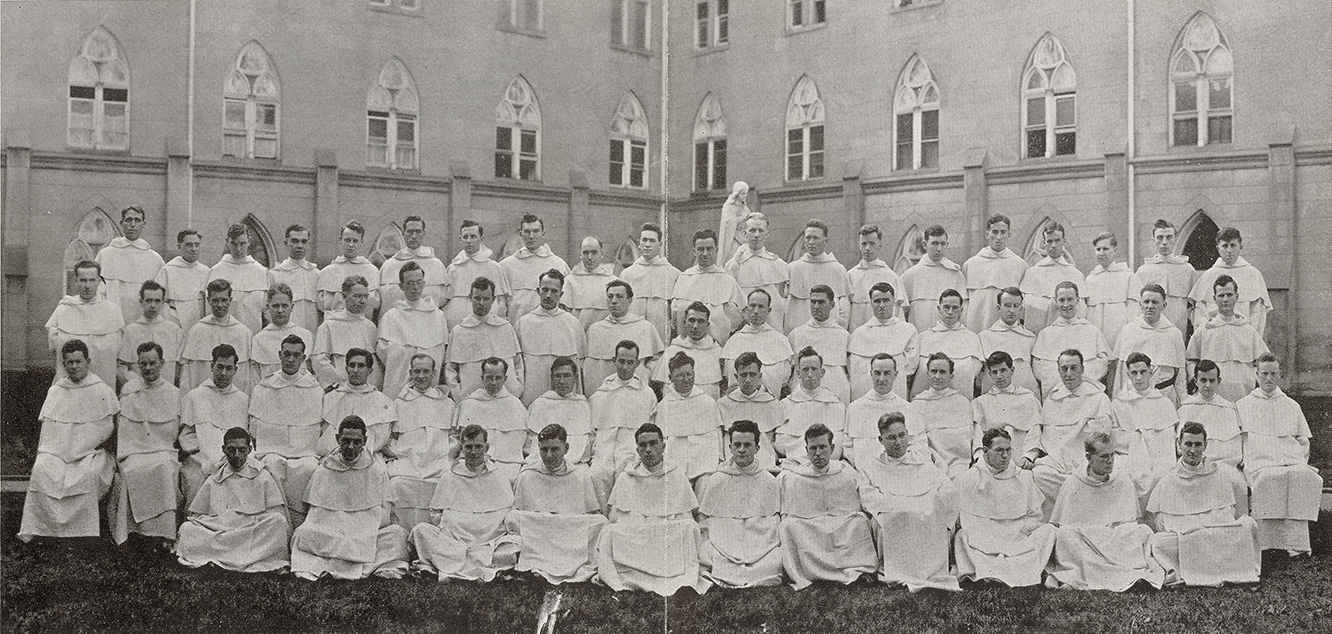
Image: Brothers of the Priory of the Immaculate Conception, 1923