

Modern man seems to be proud of his place in history. Whether it be the influence of the enlightenment which pitted reason and science over and against tradition and obedience, or the legacy of Hegel and Marx who saw humanity’s journey through history as an unstoppable train of progress, or the shocking speed of technological advancements over the last number of decades, something has made modern man proud to be of his era. Especially regarding the natural sciences, there is a great pride in how far humanity has progressed.
I hope to check our modern pride by bringing to our attention a somewhat obscure 13th-century Dominican friar, Theodoric Borgognoni. Born in 1205, Theodoric was raised and trained by his father and reputable surgeon, Hugo. He took up his father’s craft at the University of Bologna, the medical center of Europe at the time, where he also entered the Dominican order. As a religious, and later as a bishop, he continued to practice surgery, even serving as the surgeon for Pope Innocent IV. In addition to writings on equine veterinary science and falconry, his most prominent work is the Cyrurgia (Surgery), a four volume work on various medical practices of the time with supplements based on his own observations.1 Because of his scientific approach which combined both progress in medicine and a respect for the medical tradition that he inherited, Theodoric is a prime candidate to encourage intellectual humility among modern minds.
Theodoric’s work is scientific in its approach, and it yielded precision in his knowledge of medicine. He is referenced frequently in contemporary articles on the history of medicine, including the topics of breast deformity (cancer) surgeries, shoulder dislocation, sterilization techniques, and more—and this only accounts for articles published since 2020. Theodoric’s contributions are never discounted in these papers, and he is frequently lauded as accurate. One paper from 2023 was published by a group of botanists who concocted some of the mixtures he used as anesthetics.2 They isolated the active molecules in the mixtures and found both morphine and codeine (which contemporary medicine uses as painkillers), multiple muscle relaxants, and a number of adjuvants (drugs that increase effectiveness of other drugs). While Theodoric would have had no way of identifying these individual molecules in his time, this evidence suggests his mixtures were effective.3 Surely his concoctions were the results of a scientific process since Theodoric himself says, “I have not been willing to include anything [in the Cyrurgia] which I have not tested.” His methodical scientific approach yielded accuracy in his medical knowledge. His efficacious approach is sufficient ground to say that Theodoric, and medieval thinkers in general, are not to be discounted based merely on the practice of their time period.
Theodoric Borgognoni was not only a great synthesizer of the best medical practices, but his commitment to scientific truth led to positive advancements for medicine. Borgognoni, and his student Henri de Mondeville (known as the Father of French Surgery), were the first to challenge the ancient practice of encouraging the generation of “laudable pus.”4 Galen posited in the 2nd century B.C. that the most effective way to treat wounds was to encourage the generation of pus. It was not until scientists in the 19th century—including Louis Pasteur, another renowned Catholic scientist—developed germ theory and discovered that pus was frequently the result of infections. Encouraging “laudable pus” was the standard practice from Galen until the 19th century, except for a small number of physicians championed by Theodoric of Borgognoni in the 13th and 14th centuries. Theodoric’s recognition of this common error gives testament to his notable scientific abilities. Theodoric had a brilliant mind which was able to recognize truth—something true of people in any era and not just because of their era.
While his advancements in medicine were quite progressive, Theodoric maintained a respect for the medical tradition. Obviously there is something to be said for people like Theodoric who advocated for certain truths long before they were widely recognized. I am resistant, though, to say that anyone, and especially Theodoric, was ‘ahead of his time.’ Theodoric practiced great humility toward the medical minds that preceded him; he is said to be “careful to quote the ‘ancients’” and “he hesitates to disagree with Hippocrates and Galen.”5 He considered his venture to be unified with his predecessors. Whenever he did disagree, however, he did so with firmness. In his Cyrurgia, he was borderline caustic towards his contemporaries who advocated for laudable pus, saying “there is no error greater than this.”6 He wanted the truth to be clear. Theodoric’s approach was neither a blind conservatism nor an aimless progressivism. It was properly traditional: it received what has been handed down and used it for the pursuit of truth.
While we should be impressed with modern scientific advancements, Theodoric Borgognoni shows us we should not be quick to write off the methods, conclusions, and practices of our predecessors from the middle ages. His methods were scientific, his conclusions were accurate, and his view of the truth respected tradition. While modern medicine is mostly (though certainly not entirely) better than that of the 13th century, hopefully Theodoric will help us to appreciate the many good things handed down to us which we take for granted. We owe recognition to the medieval period for much knowledge of theology, philosophy, antiquity, art, music, architecture, and even science. We should humbly heed the advice of Moses: “remember the days of old, consider the years of generations past. Ask your father, he will inform you, your elders, they will tell you” (Deut 32:7).
✠
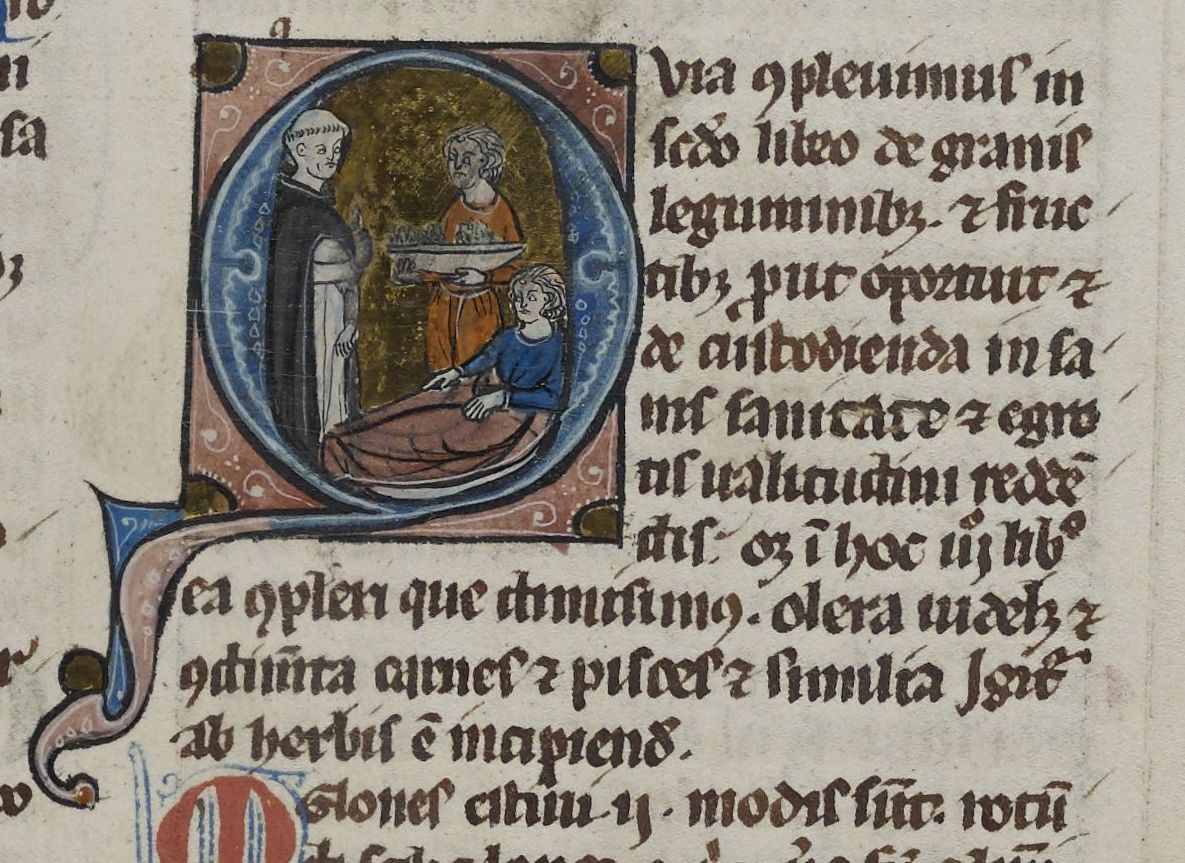
Image: Illuminated manuscript of a Dominican doctor, aide, and patient (13th century)
1 All biographical information is from Borgognoni of Lucca, Theodoric by William A. Wallace, and Borgognoni, Teodorico by Lluis Cifuentes.
2 Cavalloro, Valeria, Francesca Soddu, Sandro Baroni, Francesco Saverio Robustelli della Cuna, Eleonora Tavazzi, Emanuela Martino, and Simona Collina. “Teodorico Borgognoni’s Formulary for Thirteenth Century Anesthetic Preparations.” Life 13, no. 9 (2023): 1913.
3 Ibid.
4 Freiberg, Jeffrey A. “The mythos of laudable pus along with an explanation for its origin.” Journal of Community Hospital Internal Medicine Perspectives 7, no. 3 (2017): 196-198.
5 Fischer, H. “E. Campbell Und J. Colton, The Surgery of Theodoric ca A.D. 2267. Translated from the Latin, Volume One (Books I and II). 223 Seiten, Eine Farbige Tafel. Appleton-Century-Crofts, Inc., New York 1955.” Gesnerus 18, nos. 3–4 (1961): xvi. https://doi.org/10.1163/22977953-0180304004.
6 Ibid., 138.