

There is an ancient image that depicts the human creature as a sort of puppet pulled in various directions by strings (Plato, Laws, 644c-645b). One of the strings is a fine golden thread. The remaining strings are strong iron sinews. And, unfortunately, the strong iron sinews are pulling the puppet downward, against the attempts of the golden thread to pull him upward.
In this image, the golden thread is reason while the iron sinews are the sense appetites. Reason is finer, nobler, and it pulls us upward. It’s the best part of us. The carnal appetites, however, are stronger. This image captures the contest that often persists between reason and one’s lower appetites, and the challenge that man faces in the moral life. It seems that for reason to triumph, it will somehow have to overpower the pull of the lower appetites by brute force.
But, to its credit, the image of the golden thread permits an alternative solution. What if the iron sinews could somehow be set in line with the golden thread, and not pull down against it? In this case, not only would the tug of the golden thread of reason succeed in drawing the soul upward, but indeed it would be even stronger by having the cooperation of the iron sinews, the lower appetites. The thrust of reason would be all the more powerful by having the lower appetites set in harmony with it.
The alignment of the iron sinews of the passions with the golden thread of reason is the proximate goal of the moral life. How can such a goal be achieved? One way is through music. Music is widely popular. Nearly everyone listens to music. Everyone likes music. And not only in the present age, but down through the centuries. Music has always been enjoyable.
Not unrelatedly, music is formative. Music shapes you. We are impressionable beings; while we listen, and even after a hearing, the character of a piece of music stays with us. For good. . . or for ill.
If it is true that music shapes us, we might like to know how. In what follows, I will consider one well known philosopher’s thoughts on the role of music in forming the soul. Plato takes up this question in the Republic as he has Socrates sift through which music will be beneficial to the leaders of the republic. Socrates ends up being quite rigorous, choosing only those forms of music which emulate courage in war, and moderation in peacetime. Significantly, these two musical modes correspond to two of the cardinal virtues, indeed the very two cardinal virtues that correspond to man’s carnal appetites and emotions. The point is clear: the formative role of music is to contribute to emotional maturation by cultivating in us the cardinal virtues of fortitude and temperance.
Forming the Guardians With Music
In Plato’s Republic, Socrates considers how to put together the ideal city. In this city, Socrates envisions a ruling class of wise and good men called guardians. These men are dedicated wholly to making the city run well, to be a place of peace and flourishing. But for these men to order the city well and harmonize its elements so as to secure it peace, it is first requisite that these men have their own souls ordered well. Their souls have to be set in order, and from this order, their souls must be at peace.
The souls of the guardians are set in order and in peace by making the guardians virtuous. That is, in order for the guardians to have peace in their own souls and to be capable of bringing peace by ruling the city wisely, the guardians must be cultivated in the life of virtue. Virtue of body, certainly: they must be healthy and strong and capable of fighting well. But more importantly, the guardians need virtue of soul.
How can the guardians be made to have virtuous souls? Socrates suggests a special kind of training: “physical training for bodies and music and poetry for the soul” (Plato, Republic II, 376e). That physical training is effective for the body is obvious. But in order to train the soul, Socrates proposes exposing their souls to good music and poetry. And this should begin at a young age, while the guardians are still children and are thus particularly impressionable. Physical exercise will impress on their bodies the strength and agility needed for combat, and analogously, music and poetry will impress on their souls a kind of strength of character needed to make them virtuous.
The poetry and music used for training in virtue must be chosen wisely. Care must be taken because music and poetry-training operates by means of imitation: “[the young guardians] must imitate from childhood what is appropriate for them, namely, people who are courageous, self-controlled, pious, and free, and their actions” (Republic III, 395e). And so, it turns out, Socrates is quite picky about which kinds of music will be permitted in the city. The poetry and music must emulate the kind of character traits that belong to the good, ruling man. Everything else must be abandoned and banished from the city, as corruptive to their behavior.
And when it comes to music, the strict standard does not only apply to the lyrics. The lyrics, indeed, must emulate excellence and virtue. But the very quality of the music itself must be purified: “the mode and rhythm must fit the words” (Republic III, 398). This leads Socrates to run through the eight musical modes, prevalent in his time, and to cut out all of the modes which fail to emulate the desirous strength of character needed for the guardians. For the sake of the modern reader less versed in musical theory, the difference in mode is something akin to the difference of major and minor keys, albeit with some minute variations. Practically speaking, mode refers to the mood of a song.
Of the eight musical modes, Socrates ends up cutting six. The “lamenting modes,” such as the sad music used in dirges, end up being useless (Republic III, 398c–399a). Presumably this kind of music would breed men who are too melancholy or lethargic. So too, he notes that because the behaviors of “drunkenness, softness, and idleness are also most inappropriate for our guardians,” those “soft modes suitable for drinking-parties” are to be cut as well. “Could you ever use these to make people warriors?” he asks. No. By such a process of elimination, Socrates arrives at two remaining modes that will cultivate the proper kind of character in the guardians.
The first mode Socrates chooses to preserve is one that captures the spirit of those going into combat. He says, “leave me the mode that would suitably imitate the tone and rhythm of a courageous person who is active in battle” (Republic III, 399a). It seems that Socrates favors this martial mode especially so that the guardians and men of the republic can act well in battle. Then as now, war would have been very fearful. But fear can be counteracted by inspiring music, which tempers fear and provokes feelings of courage. This martial mode would make the guardians less inclined to fear, and more courageous. At the same time, though Socrates describes this mode as “violent,” he does not envision music that provokes a frenzied or irrational daring. Socrates continues to describe this martial musical mode, as one befitting a person who “is failing and facing wounds, death, or some other misfortune, and who, in all these circumstances, is fighting off his fate steadily and with self-control” (Republic III, 399a). Whether the battle goes well or ill, this man is not flighty with fear; he steadily does what he has to do, or at least what he can do for the preservation of his life and for the city.
The second mode Socrates keeps is one proper to peacetime. He says, “leave me also another mode, that of someone engaged in a peaceful, unforced, voluntary action” (Republic III, 399a). At first sight, the inherent quality of this second mode that Socrates envisions is vague. Clearly, he means to contrast it with the first, martial mode. But what can we say, positively, about this second mode? This second mode is simply of a man peaceful and measured, and not particularly passionate, as it describes “someone asking a favor of a god in prayer or of a human being through teaching and exhortation, or on the other hand, of someone submitting to the supplications of another . . . and who in all these circumstances, is acting with moderation and self-control” (Republic III, 399a). The second mode, therefore, is a mode of self-control in peacetime, and one of contentment. The man it emulates acts “not with arrogance but with understanding, and is content with the outcome.” There is a wide range of activities that one might be involved in in peacetime, but above all, there is a certain moderation of character that should govern the good man’s behavior. His own covetous desires and concupiscence is held at bay, allowing him a certain freedom of action and independence of spirit.
With that, Socrates dismisses all other modes of music. He goes on to apply similar reasoning to the question of musical rhythms. What’s at stake, in his eyes, is nothing short of the success of the city. These guardians, who are being raised to be “the craftsman of the city’s freedom,” must be noble men whose lower appetites and emotions do not hinder the guiding pull of reason. And so Socrates chooses music that will shape the lower appetites to better cooperate with the guidance of reason. As it turns out, the particular choice of the two modes that Plato has in mind is significant, not only for the guardians of an imaginary republic, but even for the person reading this essay.
Cultivating the Cardinal Virtues
Plato’s choice of two musical modes (one for war, one for peace) is significant when we consider the life of virtue that he and so many other philosophers envision as constituting our happiness. Whether or not we follow all the particularities of Socrates’s choices in music is not the point. But the principles which underlie his choice of these two modes, and perhaps the cut-throat spirit of banning everything else, is of value even to the modern reader. To be the best person you want to be, and to be capable of true happiness requires that you attain virtue. And in this quest for virtuous happiness, music has a special role to play.
First, what does it mean to be virtuous? Virtues are habits that empower the human person to live well, or in other words to excel at living, at being a man. The excellence of virtue has as its pre-eminent standard the very perfection of God and the order of his created universe (ST I-IIae, q. 61, a. 5). More proximately, the excellence of virtue consists in the perfection of one’s soul and that activity which conduces to the good of society, one’s city.
The perennial tradition of philosophy has named four chief virtues: prudence, justice, fortitude, and temperance. These four traits together make for the good and happy man, according to different facets of the moral life. These virtues are distinct from each other. They perfect different parts of man’s soul and have different activities. Nevertheless, these virtues grow together and often act in concert with each other.
The first of the cardinal virtues is prudence, which perfects the mind, enabling it to form right judgments about what actions to undertake. By prudence a man deliberates well, chooses good actions, and effectively carries these actions through (ST II-IIae, q. 47, a. 8). Prudence, therefore, is at the helm, keeping an eye on the end-goal, and charting out the path of acts which make for the means to achieve this end-goal.
After prudence, which perfects the mind, there are three other virtues which perfect the heart (one’s will and lower appetites). Among these, justice is the highest. Justice is the virtue by which we will to give others their due (ST II-IIae, q. 57, a. 1). This of course does not only mean what’s due in financial transactions or in a court of law. Justice looks over the entirety of a man’s behavior so far as it affects his relations with others, keeping him in right relationship with them (ST I-IIae, q. 60, a. 3).
Whether what is due is labor, wealth, the truth, or even gestures of friendliness, the scope of justice is quite broad. It inclines one toward truly desiring to do what is right for the sake of maintaining one’s shared life with family, friends, and the city.
Justice, the virtue, perfects the will. Only an immaterial power such as the will can have such a widely-encompassing object. The remaining two virtues perfect our lower appetites–those which belong to the body.
To appreciate these remaining two virtues, we must consider these lower appetites. Some of our lower appetites and emotions are simple bodily responses to good or evil things. We desire food, but are disgusted by rotten food. So too we enjoy peace and companionship, but we hate injustice. This simple physiological drive for good things (and aversion of harmful things) is called the concupiscible appetite. But sometimes, the goods of the body, or even higher goods aren’t so easy to attain. And some evils aren’t so easy to avoid. Our drive for the goods we need must be made firm to account for the obstacles between us and our flourishing. So we have a more complex physiological drive, which includes hope and courage when we feel we can overcome the difficulty, and fear and despair when we feel that we can’t. This complex physiological drive, which firms us to pursue or avoid things when there are intervening difficulties and dangers, is called the irascible appetite.
The concupiscible and irascible appetites are lower appetites which belong to our bodily, animal nature. These appetites are strong, like iron sinews. But we are not mere animals. We have reason, and can apprehend good things beyond mere sensory goods. Amazingly, our emotional life responds to this very transcendence. We have stirrings, emotions with respect to relationships and to our pursuit of higher goods (such as justice, wisdom, or peace with God). Of course, our emotions are often most vehement when it comes to lower bodily goods, but the point is our emotions are not completely unhinged from reason. They can participate in the life of reason, and can be set in harmony with reason.
The work of aligning our lower appetites (concupiscible and irascible) with reason is difficult. How can it be done? That is where the remaining two cardinal virtues come in. Temperance is the virtue which trains our concupiscible appetite. The particular work of the virtue of temperance is to restrain our lustful and covetous desires (ST I-IIae, q. 60, a. 4). Of course, the idea is not to shut these desires down completely (like cutting the iron sinew). Rather, the role of temperance is to moderate these desires and align them with reason.
While our concupiscible appetite generally needs restraining, our irascible appetite generally needs encouragement. Fortitude is the virtue which trains our irascible appetite (ST I-IIae, q. 60, a. 4). The particular work of the virtue of fortitude is to amplify our desires in the face of fear. Again, the idea is not to make us incapable of fear. Rather, the role of fortitude is to find the balance between daring and fear, so as to integrate them with reason.
Where does music come in? In the Republic, the two musical modes which Socrates chooses map directly onto the two cardinal virtues which moderate these lower appetites. The first mode captures the spirit of soldiers in war. These soldiers may indeed feel fear, but they are not governed by fear. Rather their fear is governed by their higher desire for protecting their city and whatever cause of justice they are fighting for. That is, these soldiers exemplified by this music have the virtue of fortitude. The other mode Socrates chooses befits a man in peace-time. This man is moderate in his transactions, and is balanced and content in his interactions. His desires, though they are not quenched, are pacified and governed by the higher direction of his own prudence which charts a course in his administration. The man exemplified by the second mode has the virtue of temperance. The principle underlying Plato’s choice of these two modes, therefore, is clear: the role of music in forming one’s character is to help cultivate fortitude and temperance.
What can we take from this? Putting the circumstances of war and peaceful economic transactions aside, the music we listen to should emulate one or the other (or both!) of these cardinal virtues. Granted, the reader of this essay may not be slated to be a guardian of an ancient republic. But there is no doubt the reader is called to be a guardian of his own life and of those things (and people) who are put in his care. To become a good guardian, to become virtuous, he can turn to music.
✠
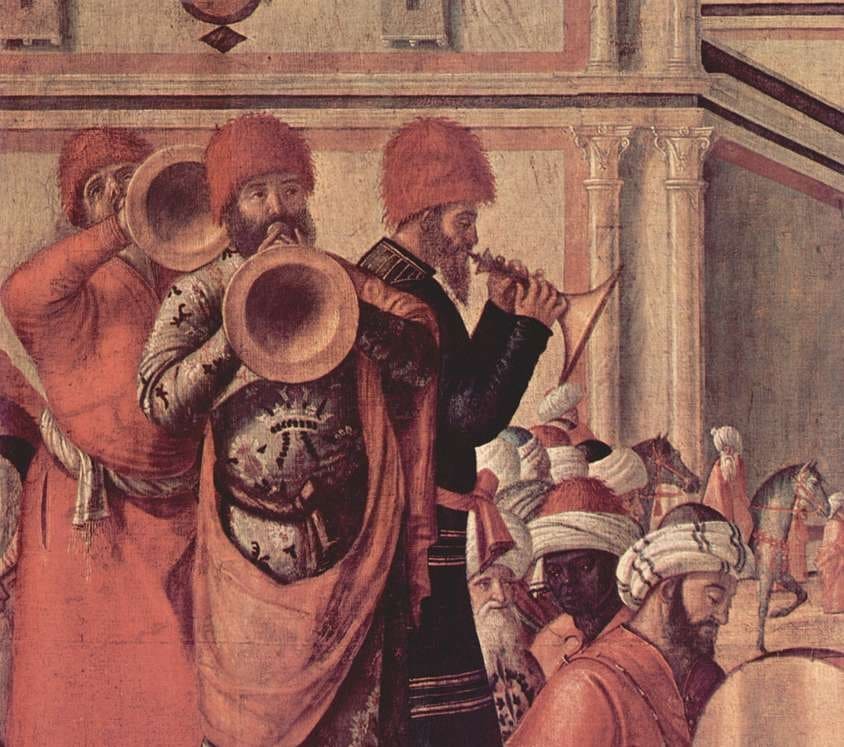
Image: Vittore Carpaccio, St. Stephen Taking Leave of His Family