


Righty tighty, lefty loosey. Many parents have taught this poetic wisdom to many children. I have a vague memory of learning this principle as a young kid. I was helping my dad build something—I don’t remember what—in his garage workshop. Six-year-old me was excited by the power this knowledge offered me. “There is no screw in the world that I, myself, cannot tighten or loosen.” When I tried to build my first bookshelf some years later, the principle of this beginner stage of screw wisdom, righty tighty, lefty loosey, remained true. I was not, however, actually proficient in my understanding of screws, for there was much more to know: length, diameter, material, tread depth, angles, drill speed, head shape, etc. Regrettably, people get stuck in the beginner stage of their understanding of screws and never realize there is more to know. Similarly, many remain in that beginner stage of their Christian life.
Most Christians were taught basic catechesis by their parents, parochial school, or catechism classes. It would be challenging to find Catholics who have no knowledge of the “Our Father,” or “Hail Mary,” the Mass responses, or maybe even the seven Sacraments. While these basic principles remain necessary for the entire life of faith, they are the beginner stages. They are the ‘how-tos.’ They are the faith’s righty tighty, lefty loosey. These things, of course, are integral to our knowledge of God. We can, however, think they are the practical ways to sufficient holiness. We think that once we know how to do them, we are set for life since we can ‘do the thing’ without embarrassment or stress. In reality, we’ve barely broken the surface of the infinitely deep sea of the Catholic faith, a sea that contains history, culture, art, music, philosophy, theology, wisdom, and more. The deeper we swim in this sea, the more we are immersed in God himself. “O the depth of the riches and wisdom and knowledge of God!” (Rom 11:33).
Sometimes we have undue confidence in our knowledge of the faith. “I know, I went to Catholic school” and “How did I not know that? I went to Catholic school” are common refrains. Catholic school teaches us great things, but it is oftentimes just righty tighty, lefty loosey: the beginner stages. God-willing, we have a lot of life to live after we have left Catholic school, and thus a lot of time when our knowledge of God should be growing ever deeper. This knowledge helps us practically—in the moral life—and, more importantly, is delightful in itself. “For wisdom will come into your heart, and knowledge will be pleasant to your soul” (Prov 2:10).
To Know Is to Do Better
The Ten Commandments are a basic component of any elementary catechism class. Many of us will be able to recite them well into old-age, because they were ingrained in us as children. This is a good thing, and we should continue to do that for generations. But we cannot stop our moral formation there. The Ten Commandments are the righty tighty, lefty loosey of the moral life. Too many of us think that we have a perfect grasp of Christian morality because we know the Ten Commandments. Then, when we try to work through a difficult moral situation, we realize there is not a commandment for every occasion. These situations make us realize there is much more to know about the moral life: teleology, virtue, habits, grace, purity of heart, discernment, and confession, to name a few. Let us consider one basic point about morality that made a significant difference in my own faith life: the purpose of the moral life is happiness. “But his delight is in the law of the Lord, and on his law he meditates day and night” (Ps 1:2).
It might surprise some of you to learn that a series of ‘dos and don’ts,’ like the Ten Commandments, is fundamentally about happiness. It is like the righty tighty, lefty loosey rule for carpenters. If a carpenter wants to become a master, he has to know the ‘rules’ of carpentry. If he ever hopes to build a Victorian bureau, he must first know that when he turns the screw to the right it will fasten his boards together. If he doesn’t know this, how will he ever hope to become a master carpenter? The rule does not inhibit him, rather it frees him to attain higher things. The more and more that he knows about the rules of carpentry, the greater freedom he will have to become a master carpenter. The Christian moral life works in the exact same way. Just as the knowledge of carpentry moves the carpenter towards mastery, so too the Christian moral life leads the human being to his or her perfection: happiness. “For to the man who pleases him, God gives wisdom and knowledge and joy” (Eccl 2:26).
The carpenter must know carpentry to become a master, and human beings must know happiness to become happy. In what does perfect happiness consist? Good things make human beings happy, so perfect happiness must be in the perfect good: God (Summa Theologiae I-II, q. 3, a. 5). Thus, the purpose of the Christian moral life—happiness—is found in God. Knowledge of the Ten Commandments, virtue, and any other moral principle is valuable to attaining perfect happiness as it contains within it some knowledge of our orientation toward God. This knowledge guides our actions to be moral—to be ordered to our happiness. “If you know these things, blessed are you if you do them” (John 13:17).
When we think of morality in this way, we can begin to treat every aspect of our life as choices that either move us toward or away from happiness in God. Basic elements of the faith, like the ‘Our Father,’ ‘Hail Mary,’ Mass responses, and the seven Sacraments are recognized as the evident ways we move toward happiness. Our knowledge of the basics of the faith often begins as practical. We learn how to do them, but sometimes we get stuck in the ‘how.’ A massive leap in the Christian life comes when one realizes that all these things make God more knowable to us. The better we know God, the better moral Christians we become. Eventually, one goes beyond the consideration of the merely practical in this knowledge and begins to find happiness in the knowledge of truth itself. This is the delight of the contemplative. “You desire truth in the inward being; therefore teach me wisdom in my secret heart” (Ps 51:6).
To Know Is to Delight
Knowledge of God is valuable for two main reasons. As mentioned above, our knowledge of him helps us live morally. Even more primary is that knowledge itself is delightful. Our happiness consists in God, and when we know the truth, we know God himself. “Jesus said to him, ‘I am the way, and the truth, and the life’” (John 14:6).
Truths of the faith invite us ever deeper into the sea of Catholic wisdom. Frequently we don’t know what we don’t know until we dive into it. Did God create man freely or necessarily? Who sent his son as redeemer and savior of the world? Who are the heirs of God’s blessed life? These questions, though not easy, are answerable. In fact, the first paragraph of the Catechism of the Catholic Church’s prologue answers all three (CCC §1). The Catechism is an excellent place to start striving to better know God. There are many more treasure troves of Catholic wisdom: devote yourself to the Sacraments, go to Mass more, attend a regular Bible study, pick up a spiritual book, go to talks at your parish, ask your friends, listen to a podcast. There will always be more wisdom to appreciate, beauty to see, and knowledge to learn in the Catholic Faith, so never stop striving. “Let us know, let us press on to know the Lord” (Hos 6:3).
It is delightful that, as a human being, you can obtain knowledge of God. A barrier to this delight is a perceived lack of external demand that tempts us to stagnate learning the faith. Put simply, we are complacent in our knowledge, because there is nothing forcing us to learn something new. I can tighten a screw, so I don’t need to know more than righty tighty, lefty loosey, right? I know the responses at Mass, and can pray along with my family when we say grace, so I don’t need to know more about God, right? This places an undue emphasis on the practicality of knowledge, and forgets that knowledge can simply be for the contemplation of truth itself (ST I, q. 79, a. 11). Saint Thomas Aquinas says that perfect happiness consists in this contemplation: contemplation of God (ST I-II, q. 3, a. 5). Knowledge of the truth is delightful. “Happy is the man who finds wisdom, and the man who gets understanding, for the gain from it is better than gain from silver and its profit better than gold” (Prov 3:13–14).
If all I ever know of carpentry is righty tighty, lefty loosey, do I know enough to delight in master craftsmanship? If all I ever know of my faith is practical, do I ever look at God and truly delight in Him? This question should be enough to motivate us all to know the Lord better. Let us pray with Jesus and include ourselves in his petition when he says, “And this is eternal life, that they know you, the only true God, and Jesus Christ whom you have sent” (John 17:3).
✠
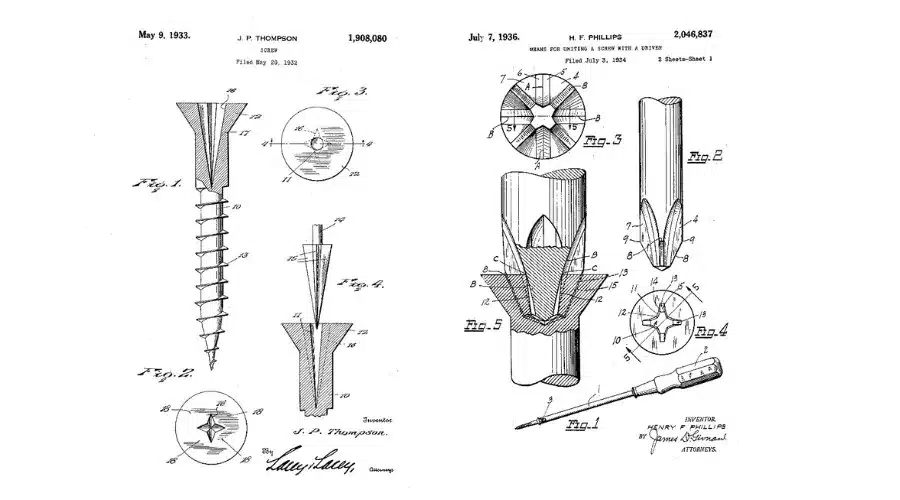
Image: US Patent Office, Left Image (Patent 1,908,080): SCREW; Right Image (Patent 2,046,837): MEANS FOR UNITING A SCREW WITH A DRIVER