Do you think relativism is unique to our times? You’d be wrong if you do. Although today relativism enjoys a mainstream privilege, it has been present all throughout the history of human thought. Relativism is based on the idea that there’s no objective reality to which we have to conform—it’s all up to us. The view that objective reality has nothing to bring to the table can also be referred to as humanism. (There are good kinds of humanism too, but this kind of humanism—where man becomes the unchallenged center of reality—is a diseased kind of humanism.) Here’s an abbreviated history of humanist thought.
A Short History of Humanism
Let’s begin with those pioneers of philosophy, the Presocratics. The Presocratics were the first thinkers on record who attempted to explain reality through a few simple principles. Some, like Anaxagoras, identified a primordial soup as the principle of all things; others, like Heraclitus, chose fire; still others chose water, air, or even numbers as the ultimate principles of all things.
But one Presocratic philosopher stands out from all the others by making a claim, not about this or that particular truth, but about all truths in general. The Presocratic philosopher Protagoras (450 BC) made the claim that all truth conforms to man. While many Presocratics thought that man’s ideas had to mirror the reality of things, Protagoras claimed that all reality actually mirrored human thought. He summed up his relativistic principle in the following pithy aphorism: “Man is the measure of all things.” Protagoras claimed that man, rather than being measured by reality, is himself the measure of reality. He’s the first philosopher to have flipped the script on truth, although he certainly wouldn’t be the last.
Fast-forward a millennium and we meet the Italian humanist philosopher Pico della Mirandola (AD 1475). Pico adapted the pagan anthropocentrism of Protagoras into a Christian humanism. While most of creation was given a determinate form, man was left to decide for himself what to make of himself. In the voice of God the Father, Pico announces:
We have given you, O Adam, no visage proper to yourself, nor endowment properly your own, in order that whatever place, whatever form, whatever gifts you may, with premeditation, select, these same you may have and possess through your own judgement and decision. The nature of all other creatures is defined and restricted within laws which We have laid down; you, by contrast, impeded by no such restrictions, may, by your own free will, to whose custody We have assigned you, trace for yourself the lineaments of your own nature. (Oration on the Dignity of Man)
Although for Pico man is not the measure of all things, he is at least the measure of himself. He does not have to conform to some pre-determined idea of what a man should be, but can decide for himself who he will be.
Four hundred years after Pico, Karl Marx brought humanism to another level: man would again become the measure, not just of himself, but of all things. In his doctoral dissertation, Marx makes his philosophical trajectory clear:
Philosophy makes no secret of it. The confession of Prometheus:
In simple words, I hate the pack of gods [Aeschylus, Prometheus Bound]
is its own confession, its own aphorism against all heavenly and earthly gods who do not acknowledge human self-consciousness as the highest divinity. It will have none other beside. (Karl Marx, Doctoral Dissertation, Preface)
In Marx’s philosophy, man is defined by his work and not by the Christian or any other divine forum. Man’s essence is no longer a given, but as in Pico’s philosophy, it is like unformed clay awaiting the creative activity of man himself. “As individuals express their life, so they are. What they are, therefore, coincides with their production, both with what they produce and with how they produce” (Karl Marx and Friedrich Engels, The German Ideology, Part One: Feuerbach). Production and what man is are interlocked so that what you make defines who you are. Man is essentially defined as homo faber—man the maker making himself.
What began as Protagoras’ pagan humanism developed into Pico’s Christian humanism and finally ended in Marx’s atheistic humanism. So how is the humanist philosophy different from the philosophy of the perennial tradition and the Catholic Church?
Philosophy, Prudence, and Art
To grasp the contradictions between humanist thought and perennial and Catholic thought, we need to outline the different kinds of knowledge. Aristotle made a fundamental distinction between speculative (looking) and practical (doing) knowledge (Metaphysics VI, 1). While speculative knowledge simply pursues truth for the sake of knowing, practical knowledge is further directed to action. But practical knowledge is again divided into prudence and art. Prudence is good thinking about human action, while art is good thinking about making things. Artistic knowledge would help us to make a sharp and sturdy knife, while prudential knowledge would help us use the knife in the way it should be used. Prudence would tell us that the knife is for cutting vegetables but not for unjustified violence.
The way that man relates to what he knows depends on the kind of knowledge he has of it. When man knows things in a speculative way, he himself is measured by the thing that he knows. So for instance, when man knows speculatively—just for the sake of knowing—that a human is a rational animal, then he is measured by that reality. His mind has to conform to the reality that a human being is an animal with the use of reason. The same goes for prudence: when man has prudential knowledge, he is measured by the thing that he knows. There is an objective right and wrong in the way he should act. Practical knowledge is measured by the laws of God and the reality of nature.
But when man has artistic knowledge of a thing, he measures that thing. Artistic knowledge measures the thing known in three ways based on three levels of causality. First, man exerts formal causality on the thing known artistically. For example, the marble known artistically will take on the form that the sculptor has in his imagination. Second, man exerts an efficient causality on the thing known artistically. He applies the chisel and hammer to sculpt the marble in the way he envisions. Third and lastly, man exerts a final causality on the thing known artistically. In other words he is the end of the artifact that he produces. The statue is for the sake of the artist (maybe he’s just trying to get a meal on the table, or maybe he’s the greatest connoisseur of his own work). As formal, efficient, and final cause of the thing known by artistic knowledge, man is the measure of the artifact. If you’re familiar with the four causes, then you’ll realize that the only cause that man does not control in the artifact is the material cause. It’s true—in art the only cause that is pre-determined is the material cause.
Where Radical Humanism Goes Wrong
Applying the distinction we’ve made between artistic knowledge on the one hand and speculative and prudential knowledge on the other, the mistake of the humanists should be clear: they replace all speculative and all prudential knowledge with artistic knowledge. If the human mind is the measure of all things as the humanists claim, then man should treat all things as if they were artifacts waiting for his efficient, formal, and final causality to shape them into whatever he wants them to be. Prudence gets tossed in the dumpster since man’s actions don’t need to conform to anything objective, but need only conform to the artistic subject. Speculative philosophy doesn’t fare much better (at least with Protagoras and Marx) since the world is either measured by man or shaped by his fabrications.
Just as in art man determines the efficient, formal, and final causes of his artifact, so in the philosophy of radical humanism, all things are treated as matter to be shaped by man. Like clay in the hands of a mad potter, reality becomes the plaything of a deranged philosophy. The practical results of a radical humanist philosophy like Marxism aren’t trivial: just think of the regimes of Lenin, Stalin, and Mao. Treating humans and reality like unformed artistic matter has dire consequences.
The desire to shape all things according to man’s own idea is the dream of the modern world. Just listen to the popular fiction writer Margaret Atwood who said that, “what we consider real is also imagined; every life lived is also an inner life, a life created.” The radically humanist way of viewing the world really is a dream because try as we might, we’ll wake up at the end of the age and realize that there was more (or should have been more) in our philosophy than we ever dreamed of. Following the advice of Heraclitus we ought not “act and speak like men asleep,” but rather walk in the light of reality (Fragment 73).
What Now?
That’s easier said than done, you might object—after all, Protagoras, Pico, and Marx all thought they were speaking the honest truth. But as Catholics we have a massive cheat code called the doctrine of the Church. Most of us wouldn’t have a chance without it. But if we want to investigate for ourselves with our own reason what objective reality is, then we can follow the perennial philosophy of Aristotle, Aquinas, and others who helped the human mind progress in its grasp of the really real. The main takeaway is this: reality, like wood, has a grain that exists prior to our thought and desire. Just as you only get good cuts when you cut with the grain of wood, so you’ll only get a good life when you live with the grain of reality. This real grain is known through speculative study—a study that stands freely without any support from man’s artistic activity.
✠
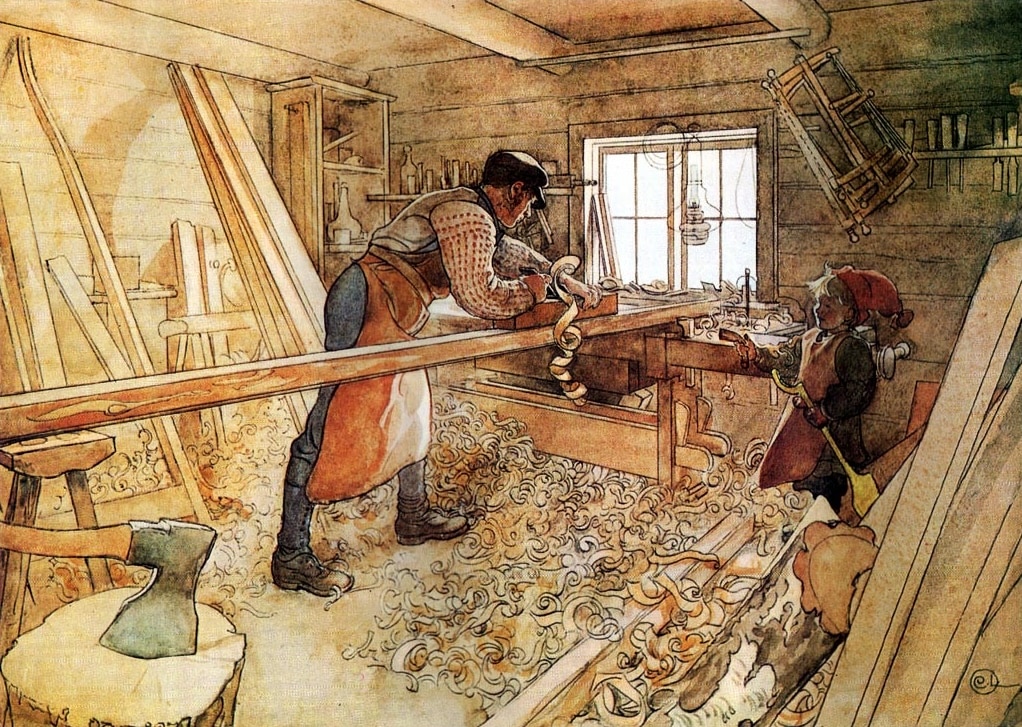
Image: Carl Larsson, In the Carpenter Shop