

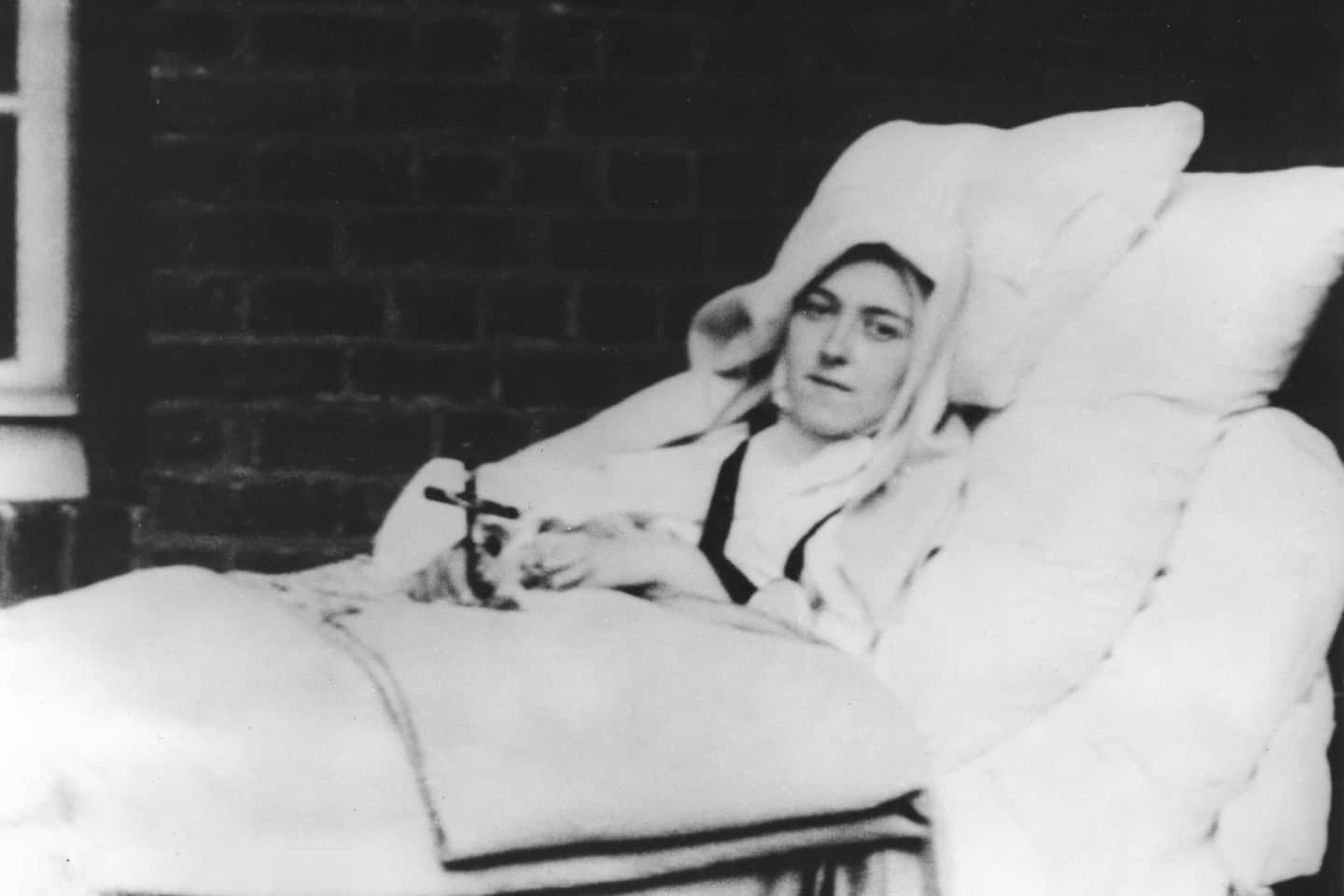
Every August, the Dominican student brothers take a week-long silent retreat. During the last retreat, I read The Story of a Soul for the first time. What I noticed is that gratitude runs through Thérèse’s life like a golden thread. On the last page of one of her original manuscripts, Thérèse wrote: Forever will I sing the mercies of the Lord. Beneath this quotation from Psalm 89 she lists the important dates of her life, or, as she says the “days of grace granted by the Lord to his little spouse.” Her life was a gift, and Thérèse was grateful for it.
St. Thomas Aquinas says that gratitude requires three things from the person to whom a favor has been granted (STh, II-II, q. 107, a. 2). First, the recipient must recognize that he has received a gift. Then he must express appreciation and thanks. And lastly, he must repay the favor according to his means at an appropriate place and time.
Whenever one of these elements is missing, we fail in gratitude. And since the second and third elements depend on this first, if the recognition of a granted good is missing, then thanks and repayment will be missing as well.
Thérèse was not lacking in the recognition of God’s blessings. She relates that, when she was four years old, her sister offered her some fabrics to choose from; stretching out her arms, Thérèse said: “I choose all!” Thérèse writes that, “This little incident of my childhood is a summary of my whole life.” She understood that “there were many degrees of perfection and each soul was free to respond to the advances of Our Lord, to do little or much for him, in a word, to choose among the sacrifices he was asking. . . . I cried out: ‘My God I choose all! I don’t want to be a saint by halves, I’m not afraid to suffer for You.” It’s remarkable that Thérèse saw all things as occasions for thanks: she knew that the good and the bad worked towards her good, for “all things work together for good for those who love God” (Rom 8:28).
Gratitude in the face of evil is not avoidance of the hard truth of life—quite the opposite. A soul that can give thanks in the face of trial is one who judges not by how things seem, but by what they truly are. Things that are evil on the surface can be salutary on a higher level. Even sin, says St. Thomas, works for the good of those who love God: for, after sin, God’s lovers rise “more cautious and more humble . . . fearing to extol themselves or trust in their power to persevere” (In Rom, c. 8, l. 6).
If Thérèse didn’t lack the recognition of God’s gifts, then neither did she lack the thanksgiving which constitutes the second element of gratitude. Story of a Soul is simply one extended hymn of thanks to the Lord. Thérèse says that “it is not, then, my life, properly so-called, that I am going to write; it is my thoughts on the graces God deigned to grant me” (ch. 1, 3r). In another place she says, “O my God, You surpassed all my expectation. I want only to sing your mercies” (ch. 10, 3r).
Thérèse recognized and gave thanks for God’s mercies, but can we say that she repaid the Lord for his mercies? Strictly speaking there’s no way that any human can repay the Lord. But proportionately we can give to the Lord the best we have, which is our love and our selves. “Jesus does not demand great actions from us but simply surrender and gratitude. . . . See, then, all that Jesus lays claim to from us; He has no need of our works but only of our love” (ch. 9, 1v).
Like any virtue, gratitude will grow with practice. And with the practice of gratitude comes joy and peace: joy, as our searching heart reposes in God’s granted goods, and peace, as our harried mind acknowledges the true order between ourselves and God. We owe God gratitude for justice’s sake, but also for fellowship’s sake. As we acknowledge God’s gifts we grow in our friendship for him, knowing that he cares for us. So today, let’s ask Thérèse to obtain for us the grace of gratitude: acknowledging the gift, giving thanks for it, and paying it back with love—a love that is itself God’s gift.
✠