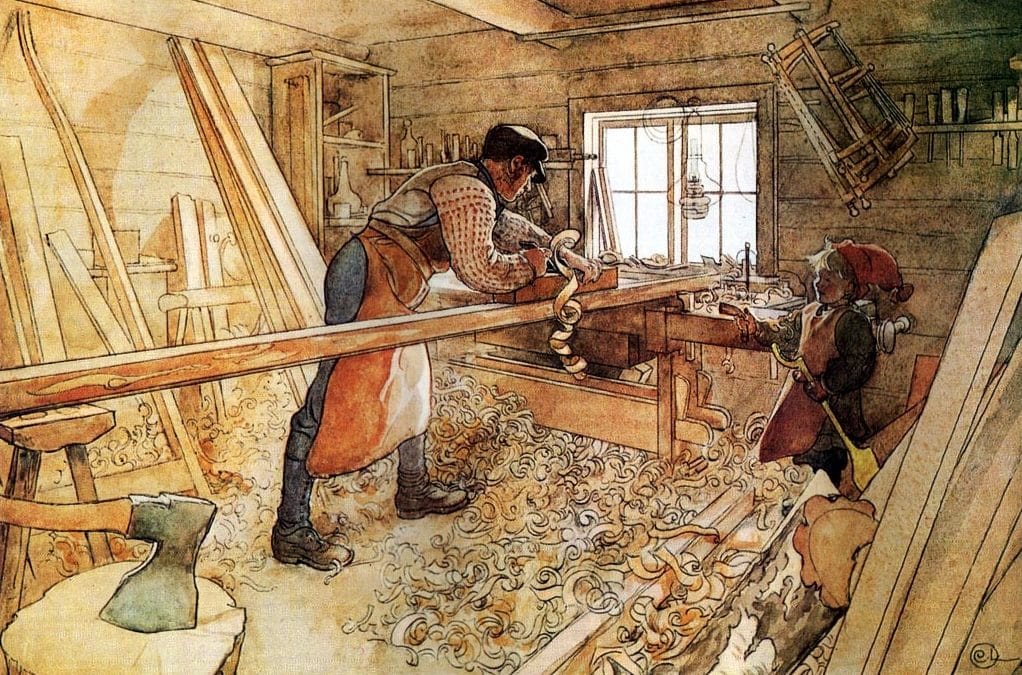


Was Saint Francis of Assisi a mason? This is probably not a word that comes to mind when we consider il povorello. Yet we learn from Saint Bonaventure that St. Francis did indeed take up masonry for a time. In chapter two of his celebrated biography of Francis, Bonaventure recalls how Christ initially called Francis to build up the Church in a very literal manner:
One day when Francis went out to meditate in the fields, he walked near the church of San Damiano which was threatening to collapse because of age. Impelled by the Spirit, he went inside to pray. . . . While his tear-filled eyes were gazing at the Lord’s cross, he heard with his bodily ears a voice coming from that cross, telling him three times: “Francis, go and repair my house which, as you see, is all being destroyed.” . . . [Francis] prepared himself to obey and pulled himself together to carry out the command of repairing the material church, although the principal intention of the words referred to that which Christ purchased with his own blood, as the Holy Spirit taught him and as he himself later disclosed to the brothers.”1
Once Francis had completed the repairs of San Damiano, he quickly moved on to another church:
After this work, to prevent his body from becoming sluggish with laziness, he set himself to repair a certain church of Blessed Peter a further distance from town, because of the special devotion which, in his pure and sincere faith, he bore to the prince of the apostles.2
Still not satisfied with having repaired two churches, he immediately commenced work on the Portiuncula:
When he finally completed this church, he came to a place called the Portiuncula where there stood a church of the most Blessed Virgin Mother of God, built in ancient times but now deserted and no one was taking care of it. When the man of God saw it so abandoned, he began to stay there regularly in order to repair it, moved by the warm devotion he had toward the Lady of the world.3
Saint Thomas Aquinas was a man very unlike St. Francis in temperament, but he did seem to share St. Francis’s love of architecture. Like Francis, Thomas had a passion for building churches. Thomas’s writings are frequently likened to the Gothic churches of the high middle ages. This comparison is so common that even in 1962 Josef Pieper could say, “The comparison [of the Summa Theologiae] with Gothic cathedrals has been cited so often that it would seem as if nothing more of value could be extracted from it.”4
One of the first authors to popularize the comparison between the oeuvre of St. Thomas and Gothic architecture was the American historian Henry Adams. Adams dedicates the final chapter of his justly famous book Mont-Saint-Michel and Chartres (1904) to Thomas Aquinas. In this chapter, Adams argues that Thomas was an architect “who undertook to build a Church Intellectual . . . both expressing—and expressed by—the Church Architectural.”5 Adams detects both deliberate and unintended similarities between the works of Saint Thomas and the works of medieval architects: “Unfortunately his greatest work, the ‘Summa Theologiae,’ is unfinished—like Beauvais Cathedral.”6
Finished or not, Thomas’s work has not yet failed. Adams describes the longevity of Thomas’ architectural achievement at length:
Saint Thomas is still alive and overshadows as many schools as he ever did; at all events, as many as the Church maintains. He has outlived Descartes and Leibnitz and a dozen other schools of philosophy more or less serious in their day. He has mostly outlived Hume, Voltaire, and the militant sceptics. His method is typical and classic; his sentences, when interpreted by the Church, seem, even to an untrained mind, intelligible and consistent; his Church Intellectual remains practically unchanged, and, like the Cathedral of Beauvais, erect, although the storms of six or seven centuries have prostrated, over and over again, every other social or political or juristic shelter. Compared with it, all modern systems are complex and chaotic, crowded with self-contradictions, anomalies, impracticable functions and outworn inheritances; but beyond all their practical shortcomings is their fragmentary character.7
✠ ✠ ✠
Saint Francis died on October 3, 1226, when St. Thomas was not much more than a year old. The two saints never met one another. Though no such visit has made its way into the historical record, perhaps Thomas had the opportunity to visit Assisi and admire Francis’s handiwork at San Pietro, San Damiano, and the Portiuncula. Francis certainly never had the chance to study Thomas’s great architectural accomplishment. And yet, time, death, and distance do not prevent God’s saints from admiring each other’s works.
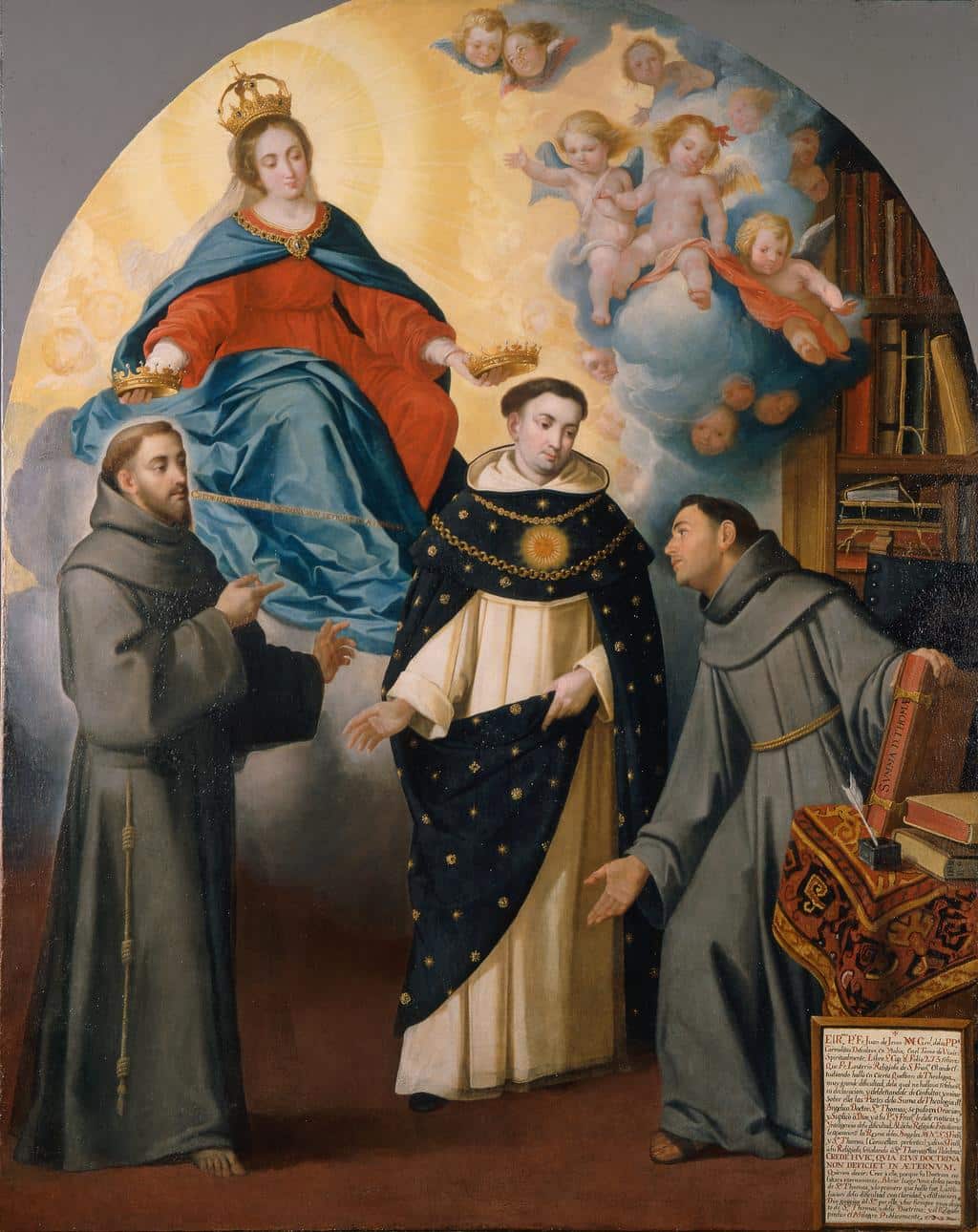
There is at least one later story that reveals to us St. Francis’s appreciation of St. Thomas’s work, namely that of Francis’s post mortem appearance to Fray Lauterio. The story dates back to at least the mid-1320s, when it was recorded by Bernard Gui, one of the first biographers of St. Thomas.8 Here is how Gui records the story:
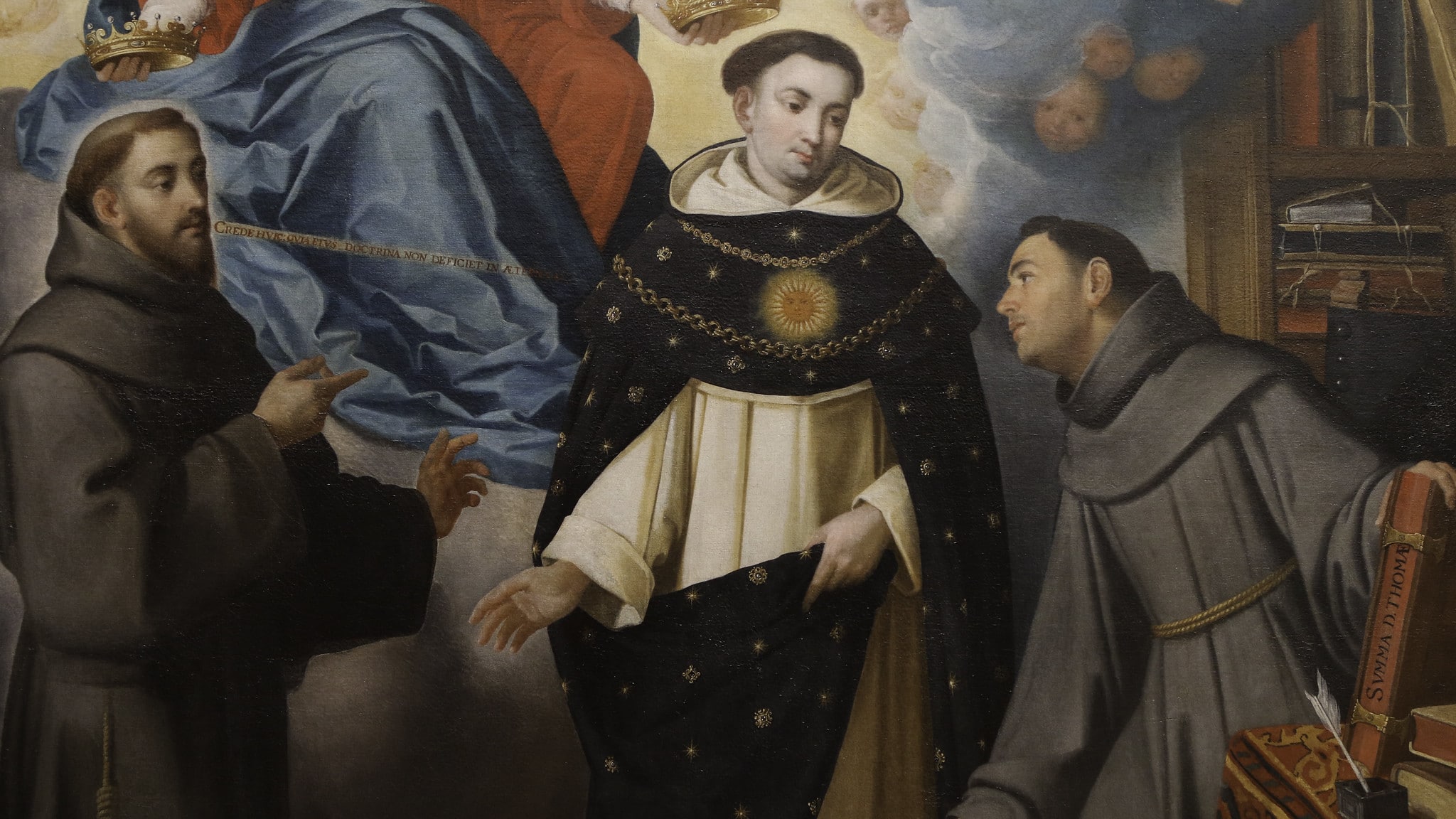
Brother Lauterio of the Order of Friars Minor, since he was perplexed by a certain question and was neglecting to seek the truth in the books of St. Thomas, devoutly prayed to God and to St. Francis that the truth might be revealed to him. And behold, in a vision he saw St. Francis and St. Thomas Aquinas clothed in a cappa adorned with bright stars, and above them he saw the Virgin Mother of God with her son, holding in her hands two bright crowns and placing them upon their heads. While he was delighting greatly in such a vision, he heard St. Francis say to him: “Believe him (gesturing toward and pointing out St. Thomas) because his doctrine will not fail in eternity.” He then awoke and, reading the writings of St. Thomas, he received certainty about what he had doubted, since the truth had been made known to him. Brother Lauterio himself recounted the aforementioned events to many people, asserting under oath that they were true.9
Bartolomé Esteban Murillo (1618–1682) immortalized this story in his famous work The Vision of Fray Lauterio, which he painted around 1640 for a convent of Dominican Nuns in Seville.10 In later years, this story and the associated painting caused some controversy among non-Thomists.11 Nevertheless, it was an anecdote celebrated by Dominicans and Franciscans alike. In 1602, Hieronymus Cabaninas, a Capuchin, invoked the story while preaching at a Dominican convent in Valencia.12 In 1697, Francisco de Mallorca, another Capuchin friar, told the same story while preaching at the Dominican Convento de Santo Domingo in Mallorca.13
Saint Francis knew what was necessary for the repair of the Church in his own day. This work, given him by Christ, was both literal and metaphorical. Here is how Bonaventure ultimately summarized Francis’s building projects:
For at the bidding of divine providence which guided Christ’s servant in everything, he built up three material churches before he preached the Gospel and began the Order not only to ascend in an orderly progression from the sensible to the intelligible, from the lesser to the greater, but also to symbolize mystically in external actions perceived by the senses what he would do in the future. For like the three buildings he built up, so the Church—where there is victory for the triple army of those being saved—was to be renewed under his leadership by the form, rule, and teaching of Christ which he would provide.14
Saint Francis repaired three material churches before he began to preach in order to “ascend in an orderly progression from the sensible to the intelligible.”15 Therefore, we should not be surprised that Francis recognized the intelligible edifice that was Summa Theologiae. After all, it is the prerogative of master craftsmen to fully appreciate the masterpieces of their peers. This is why Francis was able to recognize the perennial value of Thomas’s architectural achievement. No less than 600 years before Pius XI counseled the whole world to “Go to Thomas,” St. Francis had already admonished Lauterio in similar words: “Believe him because his doctrine will not fail in eternity.”16 This prophecy of St. Francis has been proved true, at least thus far, as Henry Adams confirmed for us: “Saint Thomas is still alive and overshadows as many schools as he ever did… His Church Intellectual remains practically unchanged… [and] erect, although the storms of six or seven centuries have prostrated, over and over again, every other social or political or juristic shelter.”17 Adams was right, but today we may say that another hundred years of storms have been unable to bring down Thomism, and, if St. Francis is to be believed, hundreds more shall likewise come and go leaving Thomas’s teachings untouched.
Today, on the 800th anniversary of the death of St. Francis, we can all imitate the example of Fray Lauterio and ask for the intercession of our holy father Francis. May he show us how to continue the work of building up the Church, and may his prayers obtain for us a greater share in the Spirit of Wisdom.
✠
Image: Bartolomé Esteban Murillo, The Vision of Fray Lauterio, photographed by Fr. Lawrence Lew, O.P.
1 Bonaventure of Bagnoregio, “The Major Legend of Saint Francis,” in Francis of Assisi: Early Documents, vol. 2, ed. Regis J. Armstrong et al. (New City Press, 2000), 536.
2 Bonaventure of Bagnoregio, “The Major Legend of Saint Francis,” 540.
3 Ibid.
4 Josef Pieper, Guide to Thomas Aquinas, trans. Richard Winston and Clara Winston (1962; University of Notre Dame Press, 1987), 101.
5 Henry Adams, Mont-Saint-Michel and Chartres (Houghton Mifflin Company, 1913), 349.
6 Adams, Mont-Saint-Michel and Chartres, 348.
7 Adams, Mont-Saint-Michel and Chartres, 349–50.
8 For the dating of Gui’s Vita S. Thomas Aquinatic see Claire Le Brun-Gouanvic, ed., Ystoria Sancti Thome de Aquino de Guillaume de Tocco (1323). Édition Critique, Introduction et Notes, Studies and Texts 127 (Pontifical Institute of Mediaeval Studies, 1996), 22.
9 Bernard Gui, Vita S. Thomae Aquinatis, 101 in Dominicus M. Prümmer, ed., Fontes Vitae S. Thomae Aquinatis Notis Historicis et Criticis Illustrati, 3: Bernardi Guidonis Vita Sancti Thomae Aquinatis (Revue Thomiste, Saint Maximin, 1931), 255. The translation is my own.
10 Fernando Marías, “Murillo Desde Antonio Palomino: Cuestiones Abiertas,” in Murillo Ante Su IV Centenario: Perspectivas Historiográficas y Culturales, ed. Benito Navarrete Prieto (Editorial Universidad de Sevilla; Instituto de la Cultura y las Artes de Sevilla, 2019), 517–18. The cartouche of this stunning painting attributes the story of Fray Lauterio to book 5 chapter 8 of On Living Spiritually by the Discalced Carmelite master general Fr. Juan de Jesus-Maria (1564–1615). However, the story is not found in the Latin text of the Ars Vivendi Spiritualiter. This section of the Ars Vivendi Spiritualiter can be found at John of Jesus Mary, Venerabilis Fratris Patris Johannis a Jesu Maria Carmelitae Excalceati Calaguritani Opera Omnia (Typis Johannis Baptistae Stecchi, 1772), 2:179.
11 It seems that for at least a few years, some Franciscans in Barcelona refused to join the Dominicans in the convent of Santa Catalina Mártir for celebrations of the feast of St. Thomas Aquinas after the Dominican fathers installed a painting depicting the Fray Lauterio story in their chapel in 1698. Evidently, the anecdote was capable of creating tension between rival theologians. Aurora Pérez Santamaría, “Aproximación a La Iconografía y Simbología de Santo Tomás de Aquino,” Cuadernos de Arte e Iconografía (Madrid) 3, no. 5 (1990): 53.
12 Hieronymus Cabanillas, “Sermon Que Predico El P. F. Geronymo Cabanillas, Predicador General, y Apostolico, de La Orden de San Francisco, Calificador Del Santo Officio, y Diffinidor de La Provincia de Valencia,” in Relacion de Las Famosas Fiestas Que Hizo La Ciudad de Valencia a La Canonizacion Del Bienaventurado S. Raymundo de Peñafort, En El Convento de Predicadores., ed. Vicente Gómez (Iuân Chrysostomo Garriz, 1602), 88, https://weblioteca.uv.es/cgi/view.pl?sesion=202609241750222225568&source=uv _im_b15587551&div=99.
13 Francisco de Mallorca, El Sol de La Iglesia S. Thomas de Aquino, Cuyas Luzes Brillan En Las Quatro Partes Del Mundo. Aplaudido En El Real Convento de Santo Domingo de Mallorca, En La Ereccion de Su Milicia Angelica, y Solemnidad de 40 Horas (Rafael Figuerò, 1697), 14, https://books.google.com/books?id=_hfsKpc5LWsC&source=gbs_navlinks_s.
14 Bonaventure of Bagnoregio, “The Major Legend of Saint Francis,” 541.
15 Ibid.
16 Pius XI, Studiorem Ducem (1923), 28.
17 Adams, Mont-Saint-Michel and Chartres, 349–50.