

How do you interpret the parable of the prodigal son? It’s almost a no-brainer—the younger son is every sinner, and the older brother is the envious and self-righteous religious person. Of course this interpretation is as old as the parable itself, and is undoubtedly a correct one. But I was surprised to learn that it wasn’t always the only, or even the primary reading.
A while back I was flipping through the Glossa Ordinaria, a standard collection of patristic and medieval commentaries on the Bible, and I found that the very first interpretation of the Prodigal Son is not about two individuals, but about two peoples: “This parable can be taken to refer to the Jew and the Gentile” (Interlinear gloss on Lk 15:11). The Gloss goes on: “This man, God the Father, had two sons, because he is the author and creator of the two lines of the human race, that is, the Jews and the Gentiles. The older son is the one who persevered in the cult of the one God [the Jews]. The younger is the one who deserted God even to the point of worshiping idols [the Gentiles]” (Marginal gloss on Lk 15:11). And later, commenting on the older son’s envy at the welcome of his brother: “The [older] son is the people of Israel who did not depart to worship idols” (Marginal gloss on Lk 15:25). The Gloss goes on to interpret every detail of the parable’s last scene in reference to these two peoples.
Now, I find it intriguing that none of us (seemingly) would interpret the parable in the same way as our fathers in faith. Why do we instantly, and more importantly, only think of the parable in individual terms, while they primarily considered it in communal terms?
As shown by the Gloss, the early doctors were much quicker to interpret Scripture with a view to the common, rather than the individual. This same tendency is present in their theology as a whole. Take predestination—a topic that awakens self-concern in all of us. Augustine, for all his awareness of his own experience, does not write a work entitled A Sure Sign That You’re Predestined. He instead writes The Predestination of the Saints, speaking about all the elect. Similarly, Prosper of Aquitaine’s magnum opus concerns not his own vocation story, but The Call of All Nations. These theologians and their contemporaries were deeply interested in the mystery of predestination as a whole, and it seems to me that the same is true concerning other mysteries of the Faith. Yet today, this mode of thinking is hard to come by.
In seeking to understand the shift in focus from the common to the individual, I’ll look first at the nature of the common and the individual. Then I’ll give some reasons that our forebears focused more on the common than we do. This will lead to a discussion of our modern focus on the individual and what we can learn from earlier generations of Christians.
The Common
The “common” is something possessed by many. We speak of common stock, a common project, or a common view of an issue. This commonality comes in degrees, which we can simplify to two. I’ll call them the “imperfectly common” and the “perfectly common.” The imperfectly common is whatever is possessed by many only before it fulfills its purpose. We might say we share a common stock of food or that two brothers share the same clothes (i.e., hold them in common). But the commonness here is imperfect. For food or clothing to fulfill its purpose, it must be used, and that very usage alienates it from others. Two people cannot eat the same piece of cake or wear the same ballcap at the same time. These goods are not common in the deepest sense.
The perfectly common refers to whatever is possessed by many even while fulfilling its purpose. Common knowledge, for example, is held in common in this deeper way. My brother and I can both know and use the Pythagorean theorem simultaneously as we calculate the cost of installing a triangular parking lot. We do not, and cannot, alienate knowledge from one another by using it—the truth we both possess is one and the same.
These examples show that materiality hinders commonality. Every material thing is by its very nature limited to a single, unshareable place. The immaterial, on the other hand, since it is not limited by place, has a much greater potential to be held in common.
Now that we’ve taken a look at the common, we turn to the individual. We call “individual” or “particular” whatever is unique to one thing. The individual is precisely that which distinguishes us from others, rather than what unites us. Just as we spoke of two kinds of commonality, so we can distinguish two kinds of individuality. The imperfectly individual is something distinct from others while still applying to many, like a species of animal. The species is distinct from all others, but it still includes other individuals under it. A species is still common in some way, and so is not totally individual.
The perfectly individual is a particular thing that is completely incommunicable. While Loxodonta africana is an individual species common to all African bush elephants, this African bush elephant is perfectly individual, incommunicable to any other thing in the whole wide world. Once again it’s obvious that materiality (these tusks and ears) increases individuality, while the more immaterial (tusks and ears in general) is more common.
In general then, the central note of the common as opposed to the individual is its shareability. The common unites many individuals in possessing a single thing all at once.
Up to this point, we’ve considered the common in itself. Many people can hold a single truth in common, as mentioned earlier. Just as we can speak of a common truth, so we can speak of a common good. We call “good” whatever is desirable—the good is the end of our actions. A common good, then, is some desirable goal that unites many individuals.
Each individual has a private good which it pursues; the common good, on the other hand, is pursued by many all at once. Think of many sailors working on the same ship. Each has his particular function to carry out, whether it be steering the ship, keeping lookout, or cooking below deck. The good of the individual is to fulfill his particular purpose. But the very reason for each of these functions is the good of the ship as a whole—the good of the whole motivates the good of each part. The point here is that every community of individuals, even the whole world, operates similarly. Each individual pursues his own good so that all may reach the common good.
The Common and the Divine
In pondering the unified purpose of all reality, Aristotle connects the common good, in its unifying power, with the divine: “To secure the good of one person only is better than nothing; but to secure the good of a nation or a state is a nobler and more divine achievement” (Nicomachean Ethics 1094b). God cares not just for this or that individual, but for all at once. God gives each creature its nature, and with that nature he gives a desire for some good that fits the nature. God creates cows, and he gives them a desire to eat grass and make calves. We would be mistaken, however, to suppose that God gives each individual a desire for its particular good alone. Like the sailors in the earlier example, each individual in the universe pursues his own good as a part of the universe as a whole. God’s intention is that the cow would eat and reproduce, and that man would eat the cow to fuel his work and contemplation, and that this work and contemplation would be directed toward God himself. Individual goods are all directed to some higher, more common good; they do not stop at their own fulfillment. The good of each individual is not God’s primary intention—the universal good is.
This universal good, moreover, cannot be anything less than unlimited goodness, since otherwise it would not be universal. God, the only unlimited good, must himself be the common good of the universe. Only God contains all perfections in non-competitive unity. Every creature displays something of God’s wisdom, goodness, and power in the world, thereby glorifying him. Further, because of God’s immateriality, he can be known and loved immediately by all knowers and lovers at once. In these ways—by representation and by the knowledge and love of rational creatures—God is sought as the common good of all, and therein lies the purpose of the universe. This is the glory of God: the communication of his goodness to all at once, so that all things proclaim his goodness as they seek him.
In creation’s inclination toward God as the absolutely ultimate good, there comes to be another common good that we could call the “penultimate good.” To show forth his glory, God chose to create not one, but many beings. And God chose to create these beings not as isolated individuals, but as parts of a single order of the cosmos (ST I, q. 44, a. 4, corp.). This order between creatures, intended and maintained by God, produces a tranquility that Augustine identifies as peace (De Civitate Dei XIX, chap. 13). All beings participate simultaneously in the goodness of this tranquility of order—this peaceful order itself is the intrinsic common good of the universe. Every creature participates in this common good by fulfilling its role in creation—once again, like sailors fulfilling their roles so that the ship sails smoothly and surely to its destination.
This peaceful order is itself intended to show forth the glory of God precisely in his identity as common good. God communicates his goodness to all creatures at once. God wants us to contemplate the shareability of his goodness, so he created a universe that imitates his own identity as common good. Had God created only one creature, or many creatures without order between them, the world would fail to show forth the particular facet of divine goodness that is its communicability. The good is diffusive of itself (Thomas Aquinas, De Potentia, q. 7, a. 5, ad 7). So without the diffusivity of a common good intrinsic to the universe, creation would lack an integral note of the divine goodness, making its imitation of God and proclamation of his glory much less perfect.
The Divine
The divine is the most common of goods and the greatest of goods. This fact makes sense of Aristotle’s words at the beginning of the last section: to love and care for the common good is a sign of the divine. Now we can understand why theologians of past ages focused on the common more than the individual: they possessed a share of divinity in some way. In the case of these Christian theologians, we know that this participation isn’t just political prudence or metaphysical attentiveness, but the grace of God, a very share in divine life. They were divinized by God’s life within them. And because of this possession of divine life by grace, these theologians came to love the divine, since likeness causes love (ST I–II, q. 27, a. 3, corp.). They loved the common good because they pondered and thereby more deeply assimilated the divine, the most common good of all. Fixation on God means (and meant for our forebears) fixation on goodness, which necessitates loving each being in proportion to its goodness. Just as the final good is first in intention, so it is first in love, since it is the most good—even formal goodness itself.
Those who love God, the ultimate good, love and intend the things closer to God more strongly than those further away. These higher goods were the object of our fathers’ thoughts and words, their love and works. They contemplated and loved the common good more than the individual good because the former is the cause and perfection of the latter.
God, God, God
How is it that today, our minds are so different? That the worldview of our fathers in faith make them seem like strangers? The short answer is that we today are immersed in the particular, both practically and speculatively.
First, the practical realm: We saw at the beginning that the common has the nature of immateriality, while the individual has the nature of materiality. Since we live in an ever more engrossing and pleasurable world materially speaking, there is less to draw us out of the individual and spur us on to seek the immaterial. Immersion in the senses, which have the material for their object, makes due recognition and love of the common good nearly impossible.
Here, the remedy lies in elevation of the mind. There are a multitude of ways to practice it: prayer in general, especially the Rosary; study; penance; sacred music. By grace, we are proportioned to mind-boggling goods, but we will only be free to reach them if we employ, with God’s help, the means to remove the obstacles in our way.
Our immersion in the particular is easy to see in our actions and feelings; the speculative component is more subtle. Still, speculative or intellectual individualism is perhaps even more harmful, since our intellect directs all our actions. Earlier theologians’ fixation on God bespeaks a love of the good, a love of perfection. They desired wholeness for themselves and for all; they contemplated and sought this wholeness. In their unwavering and undaunted focus on perfection, they understood that man is not fulfilled by self-love because man is particular and individual. Each particular man is a subject, with senses and an intellect made to receive objects in the world by sensation and understanding. As subjects, man is the substratum underlying his interaction with objects in the world. Precisely as this substratum, as a subject, man does not perfect himself by himself. He must be perfected by an object to which he is proportioned through his powers. Man cannot see without light and some bodily object in front of him; he cannot understand without some reality coming to him through his senses. The object is what does the perfecting, while the subject is what is perfected, since the object conforms the power and thus the ultimate subject to itself. A subject cannot perfect itself—it needs the object—precisely because its nature is to receive perfection from another.
Earlier Christians’ fixation on perfection was a fixation on the object, rather than the subject. Of course they explored the nature of the subject as such—much of the previous paragraph is what I have learned from their writings about the subject. But they considered the subject speculatively in the pursuit of the object—the good, the true—which perfects the human person. They did not seek perfection from the subject as such, and they did not fixate on it, because they saw that only the object perfects.
The “turn to the subject” of the modern period, therefore, plays a central role in the individualistic mentality of the contemporary world. To fixate on the subject is to fixate on something necessarily individual and thus incommunicable (funnily enough, we today consider incommunicability as a very desirable attribute). To focus on the subject is to focus on what does not perfect. To spend all our time contemplating and loving the subject is to miss what will actually fulfill us. Even human subjectivity, while of course not totally material, is still an instance of the imperfect principle in matter—potency—which cannot perfect.
Our modern individualism is bound up with our subjectivism and existentialism, to varying degrees. In focusing our minds on subjectivity, we lose our taste for the object, and so we also lose our taste for the common. We cease thinking on it and loving it, so that we simultaneously lose our taste for perfection and the good itself. The logical consequence is that we lose our taste for God.
The remedy for our individualistic illusions, and thereby for our failing friendships, marriages, families, cities, and states, is a return to the perfecting good, i.e., the object. This mental re-orientation is something we probably can’t teach ourselves. But perhaps God providentially inspired our older brethren in the faith to write so much because he foresaw our particular present-day issues. What they knew so well, they can still teach us today.
Man is a knower and a lover, so the object that perfects man most of all is God, substantial Truth and Goodness. All the saints understood (more or less explicitly) the primacy of the perfecting object, but I’m very grateful to be part of an Order consecrated to God as object of our minds: Truth. The Dominican soul refracts a ray from the lamp that is the Christian soul and shows forth the purity of an object-focused mind. We hear that Dominic spoke only to or about God, rather than about himself. We hear of Catherine fixated on the Blood, that which comes from above to cover us and make us holy. In Thomas’s words to the Crucified Christ, we hear perhaps most clearly the total focus on God: Non nisi te, Domine. We can rightfully apply to every Christian soul what Fr. Philipon, O.P., says of the Dominican: “This is the fundamental attitude of every Dominican soul. GOD, GOD, GOD.”
Conclusion
The focus on the individual almost to the exclusion of the common is a malady of the modern world. Yet it’s a malady for which we have a remedy. The moment when we find ourselves worn out and dissatisfied with everything that promised fulfillment, as we appease our lowest desires with disgust like a farmer tends swine—that very moment is the time for conversion, to “come to ourselves” like the prodigal son (Lk 15:17). God, not ourselves or material things, needs to be our focus. He must be the object of our thought and our love, because only he can actually perfect man. Similarly, those goods closer to God are the more common ones; for this reason, common goods ought to hold a higher place in our eyes than individual ones.
It may seem counter-intuitive at first, but loving the common good of the Church and of society as a whole will actually perfect you and me more than loving our individual good. None of this means that we need to neglect particular goods—we only need to order them properly. The good news is that we have what we need to work this order into our lives. A Rosary and a little St. Thomas can work wonders for the mind and heart.
✠
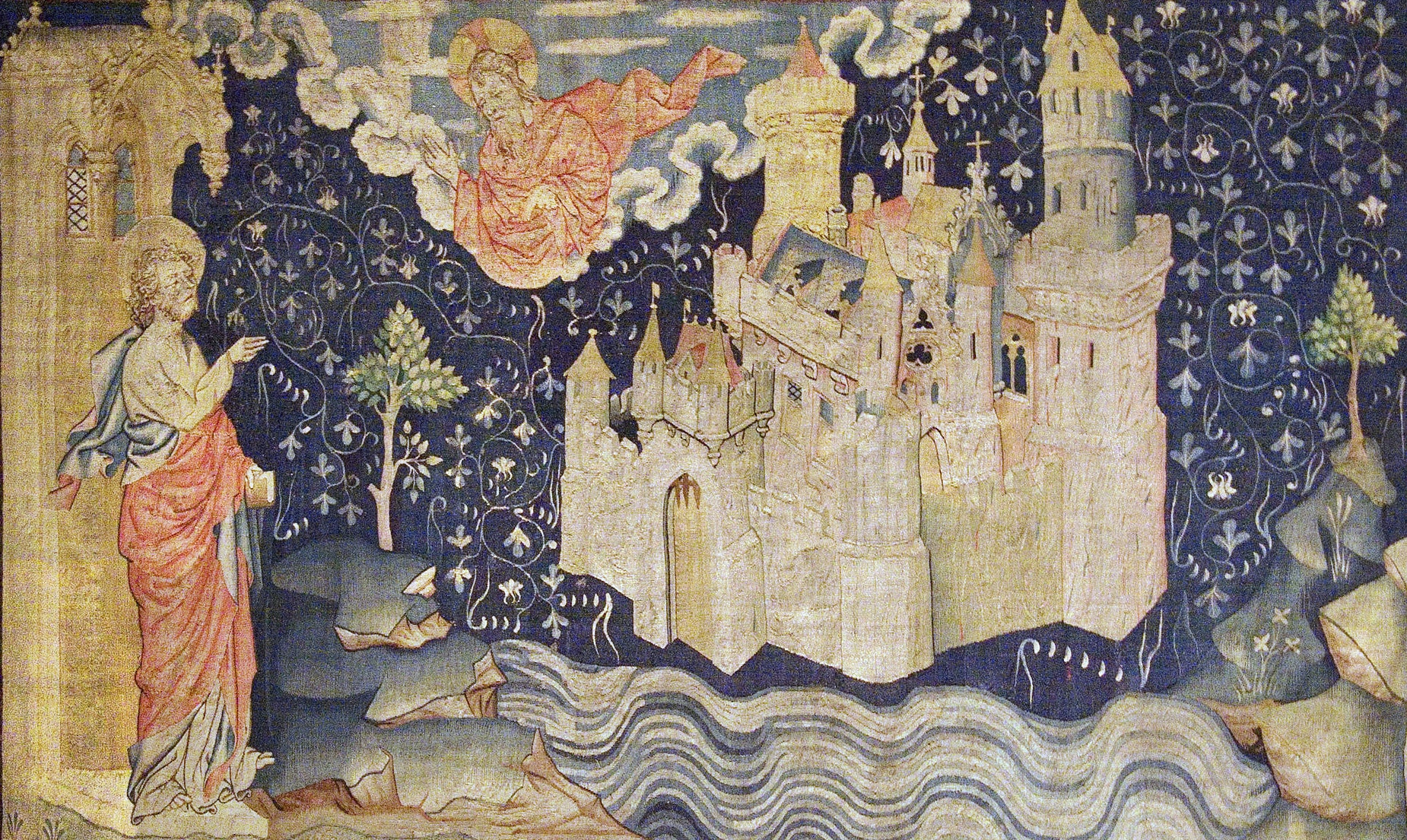
Image: Jean de Bruges, The Heavenly Jerusalem from The Apocalypse Tapestry


.jpg)