

Jansenism, Calvinism, and numerous other heresies and philosophical novelties plagued France in the 17th century. Father Jean-Baptiste Gonet, perhaps the greatest theologian of his generation, decided to break off his life of tranquil study and battle against any ideas that could, as he says, “do injury to true religion.”
Therefore I, even though the least of all, come into the fray. I interpose this shield with which I will repel the arrows, intending to defend Thomistic truth not so much by my own industry or art as by its own unconquerable strength.1
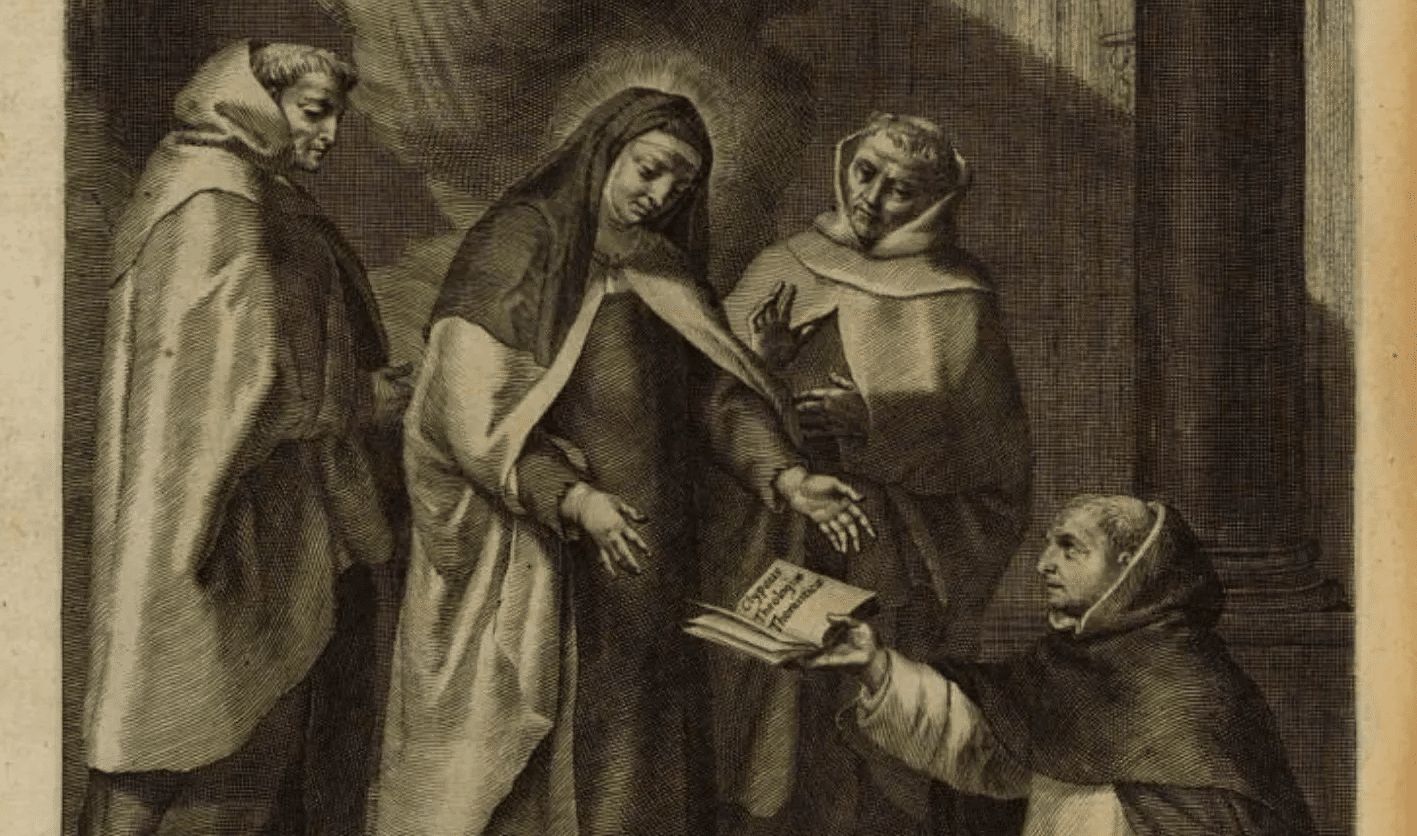
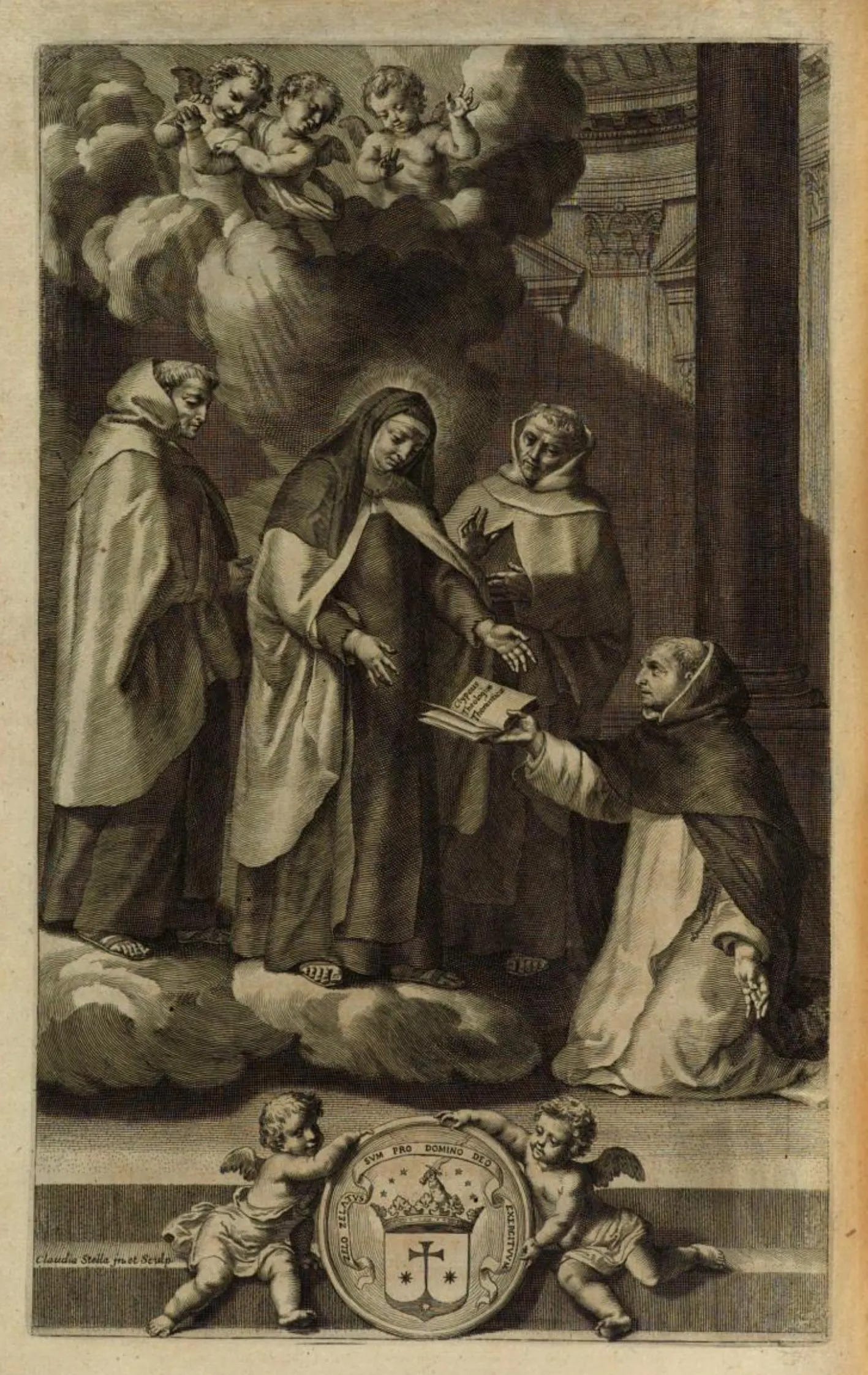
But before beginning his 16-volume Shield of Thomistic Theology Against Its New Assailants, he recognized his need for heavenly aid and sought a patron who could assist him. Whom did he choose to aid him in writing his magnum opus?
I had to dedicate this work to no one else among the saints than to you, O VIRGIN SAINT THERESA, Mother of the most illustrious institute of Discalced Carmelites, since one must suppose that the Angelic Doctor wishes that the cause of his school be commended and the works of his disciples and fruits of their endeavors be offered to no one else than to the Seraphic Virgin.
One of the reasons Gonet gives for his choice is the “wisdom joined to eminent sanctity in the Virgin.” Gonet goes on to rhapsodize about Theresa’s wisdom and sanctity with eloquence and profound spiritual insight.
The first sign of St. Theresa’s great wisdom is her writings, which are “monuments of eternal piety and wisdom” for the whole Church. Because of this wisdom, the Church, “solicitous for the salvation of her children, commands the faithful to ask (even by public supplications) to be imbued with [Theresa’s] teaching.” As with St. Thomas Aquinas, the collect prayer of the Mass for St. Theresa begs God that we may profit from the Saint’s teachings. Gonet finds this parallel very fitting since, “for defending religion and cultivating piety, nothing is more to be desired than the theological books of the Angelic Doctor and the ascetical books of the Seraphic Virgin.”
Theresa’s infused wisdom easily surpassed the acquired theological wisdom of most of Christendom’s greatest minds. Some of the wisest and most studious theologians of Church history, the famous Carmelites of Salamanca, recognized that her wisdom was not the result of human effort. They called Theresa their “mistress crowned with laurels, reared in angelic schools, educated in heavenly academies.”
It belongs to the wise to order, and so only a sage can be a lawgiver, since only he knows how to order others toward their end. In Church history up to this point, there had been many great women who founded religious houses or restored religious observance, but only Theresa became a lawgiver for both men and women.
What greater thing or closer to a miracle has the astonished world ever seen than a holy virgin who, having become the mother of a most renowned order, gave a law to men and whom men obey?
For this reason, Gonet compares Theresa to Sarah, whom God commands Abraham to obey: “Whatever Sarah says to you, do as she tells you” (Gen 12:21). He also compares Theresa to Deborah, one of the judges of Israel, since both women “encouraged men and, with raised standard, gave examples of most worthy fortitude and of manly spirit.” Saint Ambrose of Milan in his work On Widows addresses words of praise to Deborah, saying,“There were previously many judges in Israel, but no woman judge before you.”2 Gonet repurposes St. Ambrose’s words in praise of St. Theresa herself:
There were indeed many judges in Israel, but no woman judge before you, O HOLY VIRGIN, who were capable of being an example of fortitude to men, who in the camps of the Lord first took up the standard of waging war and taught men to wield arms.
Although St. John of the Cross was “a man eminent in sanctity and teaching,” still he does not have the first place in Carmel, since he, “like another Barak, was given to Theresa, whom he followed and did not lead.” Saint John of the Cross hears the same words as Barak, “This victory will not be reputed to you but will be delivered into the hand of the woman” (Judges 4:9).
Moreover, while it is true that Elijah founded Carmel, this does not make him greater than his daughter Theresa. Just as Adam gave names to the animals but Noah is “more honored” because he “saved them from destruction,” so too Elijah gave a “most renowned” name to Carmel, but Theresa “gave salvation” to the Carmelite order:
Granted Elijah gave the name, yet you, HOLY VIRGIN, gave salvation. A purer rule was recovered in later ages, and with this you recovered the double spirit of Elijah imparted not merely to one Elisha but to almost infinite disciples.
Finally, Gonet concludes his praises of Theresa by referencing her vow “of always pleasing God and pursuing the better things, whatever would yield more unto the divine honor.” He is as surprised as anyone that such a vow is even possible to fulfill. “Theresa reveals to the world these unprecedented things, closer to miracles than to virtues, and which merit the commendation of all even while they surpass it.”
Overwhelmed by the wisdom and sanctity of Theresa and unequal to the task of praising her adequately, Gonet exclaims:
Would that I could find words, O HOLY VIRGIN, equal to your wisdom and virtues. . . . But I as a suppliant offer at least this, the entire work of my theology, as a most abundant oration by which I applaud your virtues, your wisdom, your felicity.
Today, theologians and ordinary Christians alike join in the Church’s song of praise for St. Theresa of Avila and her Spouse who raised her to such heights of sanctity and wisdom. We add our voice to Gonet’s in praising her and begging for her patronage. May her intercession profit us much in the way of salvation and bring us into deeper union with Jesus Christ our Lord.
Hear us, O God our Savior, that as we are gladdened by the feast of blessed Teresa, Your virgin, we may be fed with the food of her heavenly teaching and taught by the love of her deep devotion: through our Lord Jesus Christ, your Son, who lives and reigns with you in the unity of the Holy Spirit, God, for ever and ever.3
✠
Image: Father Jean-Baptiste Gonet presenting his work to St. Teresa of Avila, originally printed in the 1669 Paris edition of Gonet’s Clypeus theologiae thomisticae contra novos ejus impugnatores.
1 All quotations from Gonet are taken from his Clypeus theologiae thomisticae contra novos ejus impugnatores (Paris: Ludovicum Vivès, 1875), vol. I, i-vii. All translations are my own.
3 This collect is taken from the Dominican missal. It is the text quoted by Gonet and the one he prayed at mass every year on St. Theresa’s feast day. The translation is from The Saint Dominic Missal, New York (1959), 1178.