

Today we republish an essay written by William Curran, O.P. from the Dominicana Journal of 1936. The relevance of its message on the importance of the Rosary perdures to this day.
✠
Night had fallen over Languedoc. Toulouse lay in dreamless slumber. The error that had reared its ugly head in that unhappy city was silent for a time in sleep. Truth, whose champions were so few and so unwanted, now at least in rest could gather courage for the coming day.
They sorely needed courage, that handful of warriors, courage to walk in constant danger of their lives, courage to struggle on in the face of what was apparently certain defeat, courage to hope that some time truth must conquer.
Silence sheathed Toulouse, a silence broken by the sound of sobbing. Of all that city’s thousands there was one whose overflowing heart forbade him sleep. In the palace of the King, deserted now except for him and the adoring angels, he sought audience. Close to the altar he poured out his problems and his longings, confident that here was one quick to hear and strong to succor.
The world of today which boasts of a consuming interest in plain, unvarnished facts should find a healthy curiosity for the outcome of that lonely vigil. For the problem that faces the world today is the problem that faced that broken hearted legate of his people seven hundred years ago in Toulouse.
He was a product of his age, and forming a part of it he loved it with all the ardor of his warm-hearted nature. Yet he stood apart from it, and surveying it objectively, saw its sins and errors. He saw men denying God in denying his universal causality. He saw their ingratitude in labeling as evil the work of his hands.
He saw men rejecting the Sacraments Christ had left them and placing on a level with impurity and sin the privileges man and wife enjoy in matrimony. He saw men thinking only of self and forgetting him who has given himself for men. Before his eyes, the greatest vices assumed the cloak of religion. Men who appeared in the sight of their fellows to be practicing the loftiest virtue were in the sight of God full of hypocrisy and sin. Above all and causing all, he saw hiding beneath a cloak of false humility the sin of Lucifer, pride of intellect, that challenge to God, terrible and foolish, “I will not serve.” He saw men denying the authority of God and of his Church, casting off the truths which the one had written in their hearts and openly ridiculing the doctrine of the other.
And seeing the sickness, he sought the cure. Like snatches of a bygone dream, visions of another age returned to him. He saw a world for the most part pagan. He saw every vice practiced and defended in the name of culture, of public good, and even of religion. Culture was the cult of the body. Public good was license for the powerful few. Religion was worship of self. He saw self-love supreme; self sacrifice unknown. He saw the pride of intellect that blinded men because they would not see.
He saw even those who worshipped the true God tainted with the spirit of their age, their religious leaders solicitous not for the inner purity of the heart but for outward forms and ceremonies. It mattered not what they were in the sight of God so long as no man could impute sin to them. He heard their only prayer—a peevish cry that Rome be overborne and God bring worldly power and greatness to his people.
He was beholding a world fallen to the lowest depths of sin and groping in the heaviest mists of error. Watching, he wondered if ever man could be raised again from such a plight. Then within a little home in Galilee he saw an angel kneel to address a virgin. He waited and Heaven waited until she replied. He watched the coming of the one who could convert the world and saw him come through Mary.
His problem was a problem no longer. He whose coming had transformed the world must somehow come once more. He had come first through Mary; through Mary he would come again. The days, therefore, he spent in preaching and teaching, but the nights he passed close to the altar, pouring out to God that which was closest to his heart—the needs of his age and the all consuming conviction that only he who had first given the perfect example of selflessness and humility would avail anything against those among whom these virtues were unknown.
Some time during those nights of vigil his prayer was answered. Once more the example of Christ lived in the world, not indeed in the same manner as when first it came, but just as efficaciously. And again it had come through Mary—through the Rosary of Mary. Where before the preaching of the saintly Dominic had accomplished little, now the preaching of the Rosary set the hearts of men on fire with love for God and desire to sacrifice self for him. He had come again through Mary and again men’s hearts were captive.
The problem that Dominic faced in his day is the problem the world faces today. Men refuse today to acknowledge God’s sovereign mastery. There are still those who thanklessly spurn his gifts, cutting from their lives as evil, things that God’s love for man prompted him to create. The sanctity of marriage is as ridiculed and outraged today as it was in Dominic’s day. Impurity has become respectable in the name of hygiene and economics. Again behind it all, because it causes all, is that fiendish, foolish cry, “I will not serve.”
If the sickness is so similar might not the cure be likewise? Are men today less tractable, more malicious than the Albigenses of Saint Dominic’s time? They are not. The same buried, stifled desire for higher things that Dominic fanned to fervor in his day exists in the hearts of men today. It lies waiting for another Dominic to do with it what he did with it seven hundred years ago. Dominic saw the remedy for his day and he prayed for its coming as the world today does not even know how to pray. But it can learn. It must learn. This much men today have in common with the saint who checked the error of his age, that they know the remedy. Mary gave it to him; he has given it to them. For the Rosary is nothing more than the simple presentation of the most important Catholic dogmas.
And the world needs dogma today because the world needs truth. Puritanism scrapped the dogma of the Church of Christ and demanded an insane moral code that was the more insane in lacking a dogmatic background. The Victorian age continued the mad imposition. Men of our generation in casting off that moral code have merely practiced pitiless logic. For to demand Christian ethics without Christian dogma is to build upon the sand a house that cannot endure. The Rosary of Mary is dogmatic. The Rosary of Mary teaches truth. Constant, fervent use of it will give that insight into the mysteries of God that is necessary for a reasonable and lasting obedience to His commandments.
The world today needs moral correction but more than that it needs dogmatic teaching, for without dogmatic teaching morality becomes an impossible series of arbitrary prohibitions with no authority men can accept and no vitality that can long endure.
Sometimes, perhaps centuries from now, men will look again through the pages of history for the solution to the problem the world is facing today. They will find its solution in the first century. They will find it again in the twelfth century. What they will find in the twentieth century depends upon present day ability to see as clearly as Dominic saw and to pray as fervently as he prayed for the truth which will set men free.
✠
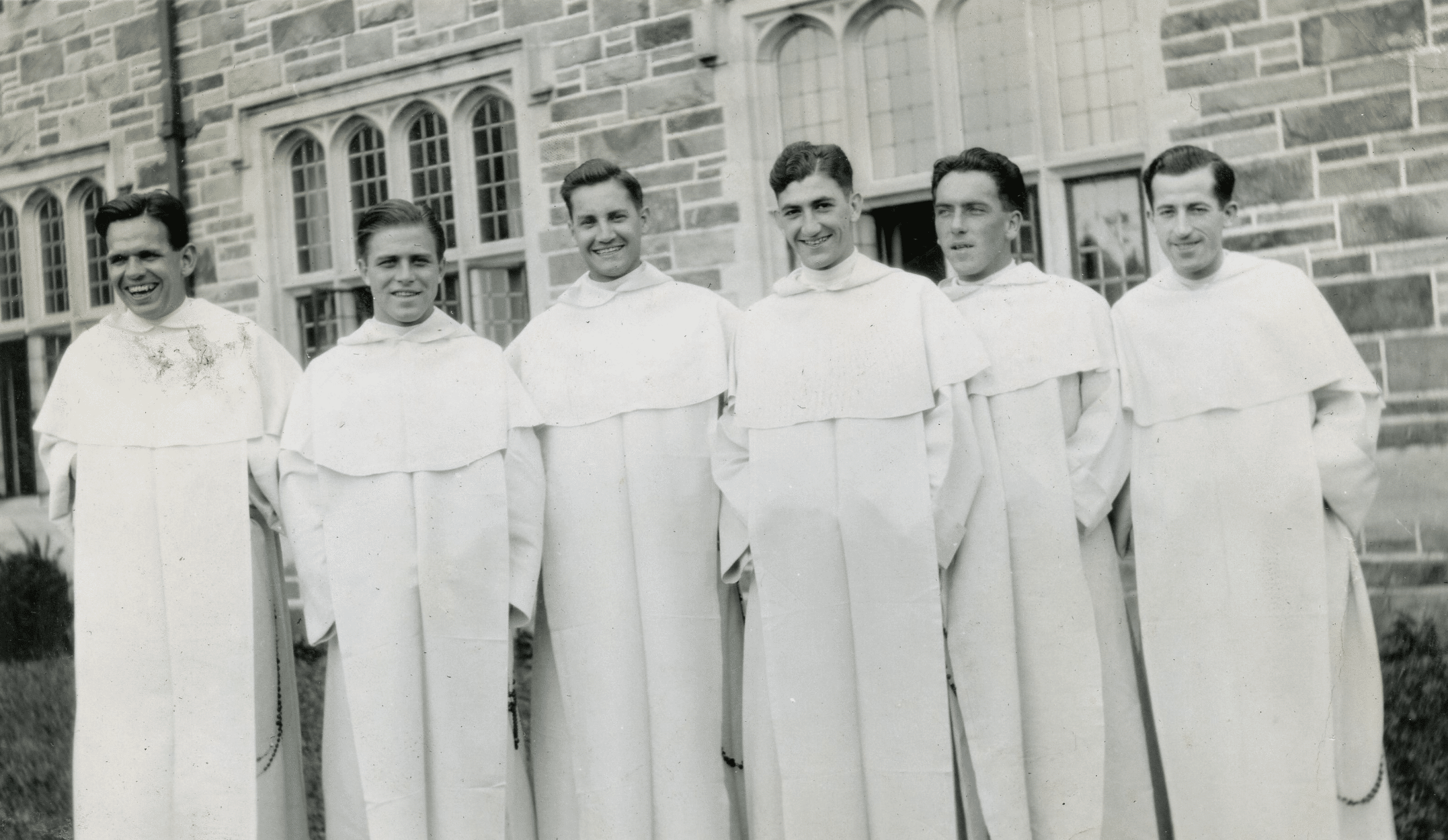
Image: Dominican Province of St. Joseph Archives