

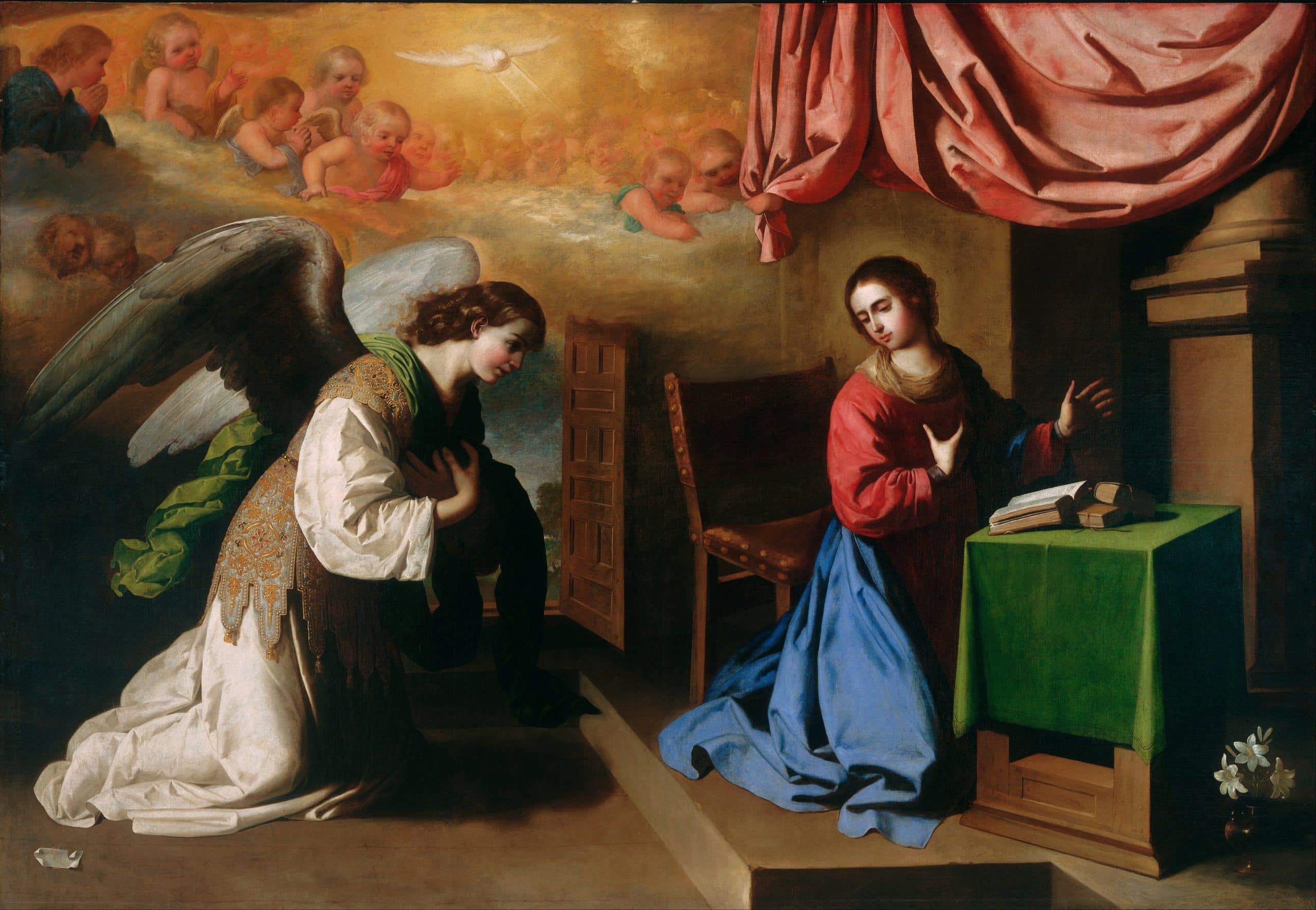
“Nothing will be impossible for God” (Luke 1:37). By this one little phrase the weight of despair is lifted off our shoulders and every person finds a firm reason to hope. God says that he will do the physically impossible in Mary: although she is a virgin, she is to conceive a Son. He also asks her to do the socially impossible: to endure the calumnies and stares of her acquaintances who would surely suspect her of sin. But, lock step with God’s request for the impossible is the revelation of his mercy. Yes, Mary was asked to do the impossible, but she responded with prompt obedience, for she did not doubt the archangel’s message: “Nothing will be impossible for God.”
Once this small phrase sinks down to the depths of your consciousness, it has the power to change you. But it must sink all the way to the depths, past every other fundamental notion of yourself and of the world. Every word from God is worthy of our trust as most true. If you let this idea implant itself in you, your whole life can be shaped by it. More fundamental to your identity than your self-consciousness, internalized embarrassments, deprivation of love, and cynicism is the reality that you are God’s beloved child, and God offers you the power to do the impossible: to live a divine life eternally in love with him.
Once that truth becomes the bedrock of your thoughts and your emotions, you can sprint forth in the spiritual life. This is “the reason for our hope” (1 Pet 3:15) which St. Peter commands us to proclaim: God is merciful, his love extends to sinners, to the poor in spirit, to those who suffer and are incapacitated. Hope never fails because God is infinite mercy—we can unceasingly reach out to him for aid to attain the destiny he has made for us. God will lavish his supernatural grace upon us so that we can love him, follow his commandments, and attain eternal life with him. When we recognize God loves us, we do not have to fear what is impossible for us. We can have great confidence in God that he will accomplish it in us because he loves us.
This hope is exciting, but one can be tempted by its apparent dissonance with reality. God has revealed that
He commands his angels with regard to you,
to guard you wherever you go.
With their hands they shall support you,
lest you strike your foot against a stone.
You can tread upon the asp and the viper,
trample the lion and the dragon. (Ps 91:11–13)
But how many people do we know who put their hope in God and yet don’t seem to slay their dragons? A final characteristic of hope challenges us: hope is a supernatural movement never to depart from the path that leads to eternal happiness, not a movement that ensures everything will go well with us in this world. Gabriel the archangel announced to Mary the great vocation to which she was called, but that vocation also meant great suffering in this life. The fact that the saints had audacious hope in God, but sometimes suffered grievously in this life, challenges us to shift our horizon for what hope means. If God really is our happiness, then the greatest kind of hope is not an expectation of earthly felicity, but rather a bold trust in God’s love for us in spite of every challenge and suffering, knowing that nothing in this world can separate us from the love of God (cf. Rom 8:39). In this manner, Mary faced the opinions of others and the sufferings of her Son with boldness, never faltering in perseverance, for she hoped in God who is her sole joy, and with whom all things are possible.
✠
Image: Francisco de Zurbaran, The Annunciation