

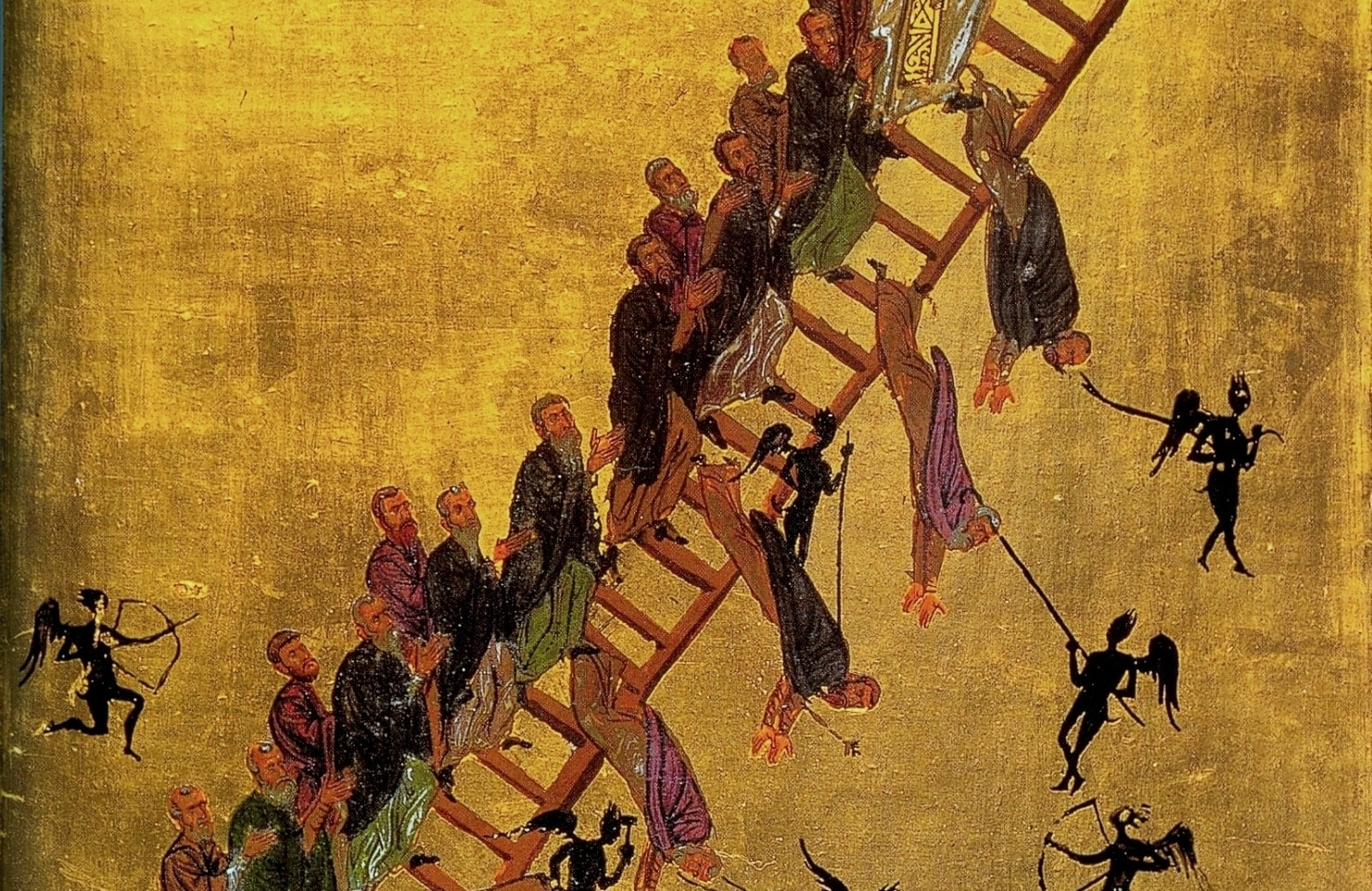
In many of our struggles with sin there comes a certain decisive moment. Up to this point, it seems we have already exhausted all our resources: our willpower has not been strong enough; our spiritual reading, while enlightening, has failed to produce the virtue we lacked; even our prayer has not turned things around. Eventually, we reach a fateful junction, a fork in the road. The path we are on now widens and bears to the left, becoming the road of complacency and sloth, eventually arriving at despair. A new road begins on the right and is narrow, leading over a high wall that we can only just see beyond. It is the only way out, but actually climbing over that wall seems impossible, even ridiculous. Nevertheless, as we fast approach that junction, the truth forces itself upon us, and something escapes from the depths: “This can’t go on.”
That quote, “This can’t go on,” comes from the book Perelandra (p. 119) by C. S. Lewis, and the scene in which it occurs perfectly captures this decisive moment. Perelandra is the second entry in Lewis’s acclaimed The Space Trilogy. The protagonist Ransom is chosen by God to travel to the planet Venus for an important but unknown purpose. That purpose gradually becomes clearer as he discovers on Venus another race of rational creatures, or rather, its two original parents, the Green Lady and her King. Like our own original parents before the Fall, these new creatures are still young, walking in the presence of God, but when Ransom finds the Green Lady, she is alone. Her King is away, and the Devil has already initiated his attack. Ransom discovers that his arch-enemy, a materialist radical named Weston, has also made the interplanetary voyage, and his personality seems off, even unstable. All of a sudden, Weston’s strange behavior betrays a sinister cause as he yields to full demonic possession. Now the “Un-man” taking Weston’s place sets out to recreate what he once accomplished in Eden.
Days go by, each one like the last. The Un-man deploys his tactics, tempting the Green Lady into disobeying God’s command, while Ransom argues on God’s behalf. For the present, she remains resilient, often indifferent to the Un-man’s suggestions, but Ransom can tell that the Enemy is slowly gaining ground and that his own arguments are not making it up. Something needs to change. Something miraculous needs to happen. “This can’t go on.” Ransom begins to brood, “The presence of the Enemy was in itself a kind of Miracle. Why did Heaven work none?” If God will not act himself, then surely he must send someone else. “Where is [God’s] representative?” (120).
Ransom, I contend, is at the precise junction I mentioned earlier. Nothing short of a miracle is needed to ascend the wall looming before him, but he knows it must be done. All of a sudden, in the space of a mere moment, he realizes both what needs to be done and whom God has elected to do it. Ransom must kill the Un-man, fight him tooth and nail. Ransom is God’s chosen representative. Everything Ransom says in the following pages, to himself and to God, mirrors our thoughts exactly when we reach this junction: disbelief, excuse, rationalization. “Oh, but this is nonsense” (121), “I’ve done all I can” (120), “When in all my life . . . did I ever win a fight?” (124), (and this particular gem) “It stood to reason that a struggle with the Devil meant a spiritual struggle . . . the notion of a physical combat was only fit for a savage” (122).
That last maneuver, I argue, reveals the true nature of this scene. It is a distinctive attack of the Enemy. After all, the Devil himself is immaterial, a pure spirit, so it is no wonder that he wants us to fight on his home turf. Nevertheless, we continually trick ourselves into thinking we can: a new prayer, some new spiritual reading, a firmer will. In reality, these “spiritual measures” become nothing but disguised excuses, our techniques for avoiding God’s will. We know what must be done. Like Ransom, we need only succumb to the brutal fact: we are God’s chosen representative. What this implies in each of our concrete situations will of course vary. It might mean gathering up our occasions to sin and physically disposing of them, or finally approaching that loved one we hurt and asking for their forgiveness, face to face. Whatever it may be, it means doing something violent to the extent that it means actually using our bodies.
Here in Perelandra, Lewis is bringing to the surface the incarnate nature of spiritual combat. This is reflected in Ransom’s critical realization: it is a trick of the Devil to think that “spiritual combat” means only using the part of us that is spiritual. God made us soul and body, and while the body is what makes us weaker than the Enemy by nature, it is also the precise instrument by which we are meant to overcome him. In the body, our nature comes equipped with a built-in nuclear option, so to speak, and God never intended it to lie dormant. He used it himself when he became flesh and mounted the cross. To defeat the Enemy’s spiritual malice once and for all, God himself deployed a physical, bloody, and—in a sense—violent solution. What Ecclesiastes says is true; there is “a time for war,” and the winning gambit is the Incarnation (Eccl 3:8).
✠
Image: St. Catherine’s Monastery, Mount Sinai, Egypt, The Ladder of Divine Ascent