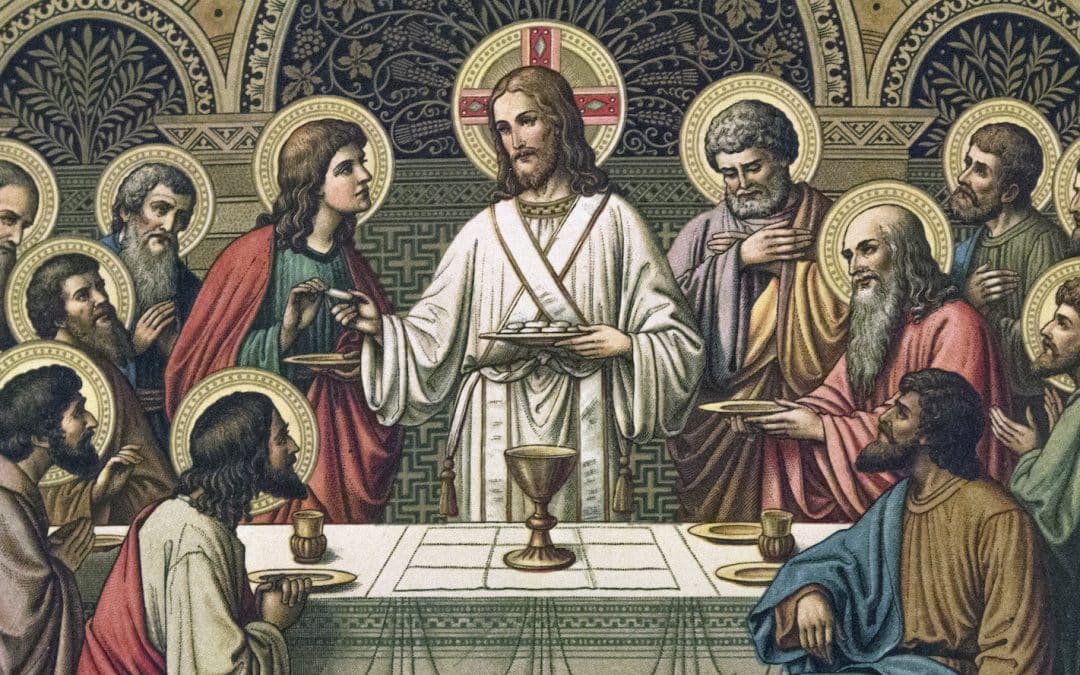



What does play have to do with liturgy? At first glance, the two activities seem diametrically opposed. Liturgy is a solemn act in which we pray to and worship the one true God, while play is meant to be silly and entertaining, the activity of children or the recreation of adults. Against the backdrop of this apparent opposition, the twentieth century priest-theologian Romano Guardini presented a startling alternative thesis: “[Liturgy] is not work, but play.”1
Yet, this likening of liturgy to play was not something entirely new. As the Jesuit Fr. Hugo Rahner demonstrates, it has deep roots in Christian mysticism stemming back to the third-century martyrdom account of Sts. Perpetua and Felicity who, upon arriving at the eternal heavenly liturgy, are greeted with the words Ite et ludite—“Go and play!”2 If the heavenly liturgy is described in the tradition as something playful, then it is worth considering how, especially given that the earthly liturgy is a participation in and preparation for the heavenly. This “how” is found in the analogy between liturgy and play, which establishes the necessary contact for making insightful comparisons and drawing out useful likenesses. Thus, the aim of this essay is to systematically construct the analogy, underscoring with the help of St. Thomas Aquinas the fundamental points of contact between liturgy and play. Ultimately, doing so will enable us to articulate further insights into the nature of liturgy and its relation to recreative fun.
Defining the Terms
Guardini recognized that the analogy between liturgy and play possessed a certain rhetorical force in an age dominated by “grave and earnest people, who make knowledge of the truth their whole aim, see moral problems in everything, and seek for a definite purpose everywhere.”3 In other words, the people of the early twentieth century needed to be challenged to levity. Today, our situation is, on the whole, quite different: we could use more of the solemn and sublime. Thus, statements like Guardini’s describing liturgy as “the sacred game which the soul plays before God,” may lead some to think that liturgy is not just like play, but that it actually is a kind of play.4 To avoid this conclusion, which conflates, instead of comparing liturgy and play it is necessary first to distinguish them by defining the terms of the analogy.
Play
Though it would be easy to write off play as mere entertainment, play is actually necessary for human beings in this life. The early monks and nuns of the Egyptian desert, with their usual penetrating insight into the human condition, recognized that when the human mind intensely concentrates on some activity, whether work or contemplation, it becomes weary, like a bow held taut for too long. Unless the bow is relaxed, it will snap. So too with the human mind, and play is the activity that provides this relaxation. When treating the virtue of eutrapelia, which governs the right use of play, St. Thomas clarifies that this relaxation or refreshment of the mind is found in delight, or simple pleasures. Thus, play is defined as those “words and deeds,” those activities, “wherein nothing further is sought than the soul’s delight” (ST II-II, q. 168, a. 2, resp.).
Liturgy
Finding a suitable definition for liturgy poses two distinct challenges. For one, there is no widely accepted definition for it, and St. Thomas doesn’t use the word liturgia even once. The Catechism of the Catholic Church, however, does provide an orientation for answering the question by noting that “the word ‘liturgy’ originally meant a ‘public work’ or a ‘service in the name of/on behalf of the people’’ (CCC §1069). In its Christian usage, the word was developed to mean the Church’s participation in the opus Dei, the “work of God”: “The liturgy then is rightly seen as an exercise of the priestly office of Jesus Christ. . . . In it full public worship is performed by the Mystical Body of Jesus Christ, that is, by the Head and his members.”5
This gives rise to the second major challenge: liturgy is a complex set of acts in which both the Church gives public worship to God and God offers himself to man as the object for his contemplation and the source of every grace. Our focus here is on the human side, that aspect of liturgy in which man is active, giving “full public worship” to God—which for the Christian is a participation in the worship of Jesus Christ, ascended and enthroned in heaven. With this emphasis in mind, “liturgy” is seen to closely resemble what St. Thomas calls the cultum divinum or cultum religionis Christianae, often translated as “divine worship” and “Christian worship,” which consists in public acts of worship governed by the virtue of religion (ST II-II, q. 81, aa. 1–2). Thus, I propose the following working definition: Liturgy is the ensemble of the official, public acts of worship offered by the Church—Head and members—to God, and in and through which God also offers himself and his grace to men.
Constructing the Analogy
Having defined the terms, we can now proceed to construct the analogy between liturgy and play—i.e., to establish what is common by analyzing the terms, drawing distinctions, and then resolving them in a final synthesis. While St. Thomas has nothing to say directly on the comparison of liturgy to play, he does develop another, similar analogy when commenting on the Latin text of Sirach 32: “Return early to your house, both to convene there, and there to play and think upon your ideas.”6 Saint Thomas recognizes that in this passage from Scripture, the sacred author employs a comparison between play and contemplation. Taking the occasion to comment on this analogy, St. Thomas argues that there are two aspects of play that support its comparison with contemplation. First, “play is delightful, and the contemplation of wisdom holds the greatest delight.”7 Second, “the operations of play (i.e. games, jokes, etc.) are not directed towards something else but are sought on their own account; this is also true of the delights of wisdom.”8 These same two aspects enable us to construct the analogy between liturgy and play at the most fundamental level.
Energeia, Not Kinesis
The second aspect of play identified by St. Thomas, which can be briefly restated as “play is for its own sake,” provides a helpful starting point. If I were to ask little Susie, “Why are you playing hide-and-seek,” it would be perfectly acceptable for her to reply, “Because I want to play hide-and-seek.” The key is to distinguish here, following Aristotle, between two different kinds of action: kinesis, or motion, and energeia, or activity.9 A “motion” is an action directed towards something else; it is a means of achieving some end that is extrinsic to the action, e.g., walking as a means of getting to class early on a Monday morning. “Activities,” however, are done for their own sake; the end is intrinsic to the action itself, like taking a stroll on Sunday afternoon. Nevertheless, certain activities can be used as the means to another end, even while remaining activities in their own right. My stroll on Sunday afternoon could also be my chosen means for getting to Sunday dinner at Grandma’s, but the stroll still remains enjoyable in itself (and even something I could have chosen for its own sake were I not going to Grandma’s).
The above example illustrates that, although play is the most evident example of an action done for its own sake, it is not the only form of energeia. In fact, all virtuous actions, if they are truly virtuous, fall into this category.10 Liturgy, considered as the ensemble of official, public acts of the virtue of religion carried out by the Church, is thus also energeia and not kinesis. It is done for its own sake insofar as the end—rendering God the honor and service due to him—is attained in the very doing of the liturgical action. Furthermore, within and through the liturgy, God gives himself to man as the object for our contemplation and love—our ultimate and final end. This very basic similarity, that liturgy and play are both types of virtuous energeia, is thus the foundation for the analogy between the two. Yet the analogy’s usefulness is more firmly established if we consider delight, that first aspect of play identified by St. Thomas.
The Delights of Play and Liturgy
Saint Thomas teaches that what we seek in play is nothing other than delight, or pleasure (ST II-II, q. 168, a. 2). Thus, play is like the mascot, or prime example, of pleasurable activities. When we think of “fun,” the mind typically jumps first to play or recreation. But play, of course, is not the only pleasurable activity. Following Aristotle, St. Thomas identifies pleasure as the affection that accompanies any unhindered activity natural to man (ST I-II, q. 31, a. 1, ad 1). To borrow Aristotle’s own image, pleasure is like “the blossom of youth . . . on those in the flower of their age”11—that is, it adorns and is as inseparable from the perfection of an act as the blossom is inseparable from the perfection of the flower, or health from the perfection of those in the prime of their life.
Now, liturgy is certainly an activity natural to man, for he is a creature and thus has a natural obligation to pay honor and service to his Creator, the source of being, life, and every good he possesses (ST II-II, q. 81, aa. 1–2). Moreover, God created man as a social being, so some part of the service and honor he owes to God must be fulfilled in a social, and so public, way. The consequence is that liturgy in itself can be a truly delightful activity, even if human weakness, or simply an unfamiliarity on our part, often prevents it from being so. Still, with time, as we grow in the virtue of religion, we begin to experience this pleasure. Liturgical activity becomes “second nature” to us—we feel at ease in the public worship of God, much like the ease of the master musician at a recital, and not the idle ease of the couch potato slouching before the TV.12
Furthermore, the delights that can arise from the liturgy are twofold, according to the bodily and spiritual elements of our human nature. First, they are sensible, given the public, corporeal nature of liturgy: the processions, the music, the incense—all the “smells and bells” delight our senses, or at least they can, if done well. Second, and more principally, the delights are spiritual, since the principal act of religion—devotion—is an interior act of the will propelling us more intensely toward God (ST II-II, q. 82). These delights represent in a unique way those of man, for we are the only creatures capable of experiencing both sensible and spiritual delights.The virtuous energeia of play and liturgy are thus analogically related, in a manner unique from all other virtuous activities, because of the way they pertain to delight. Play is essentially about delights, inasmuch as playful activities refresh the soul for higher delights. Liturgy, while not essentially about delight, can give rise to delights that encompass the totality of the human person, body and soul. It is also the place in which God gives himself to man as the proper object of our loving contemplation and so disposes us to the highest form of delight, delight in God himself.
Articulating Insights
Having a stable analogy enables us to articulate further insights into the nature of liturgy and its relation to play. While there are many insights that the analogy between liturgy and play affords, I would like to conclude this essay by offering just two.
The first insight concerns the interaction between liturgy and play. Play is the activity which refreshes the mind and thus disposes it to engage more intensely in other activities. Liturgy, on the other hand, is an activity that requires the utmost concentration since it deals with the worship of God. If we recall that one activity can use another as a means, like using my Sunday stroll to get to Grandma’s for dinner, it becomes apparent that we can actually direct our acts of play to the further end of participating in the liturgy more easily. For example, one could simply take the time on Sunday morning—after an exhausting week of work and all the household chores of Saturday—to pause and relax, to drink a cup of coffee and enjoy reading something for pleasure so as to dispose oneself to focus more intently at Mass.
This should not be surprising, since God himself recommends, and actually commands, that we take such a rest: “Six days you may labor and do all your work, but the seventh day is a sabbath of the Lord your God” (Exod 20:9-10). The commandment to rest from servile work on Sunday is not, then, an arbitrary decree. In order to worship God well on the Lord’s Day, we need to be properly disposed to do so—one element of which is ensuring we are refreshed and ready to participate more intently in the Mass. After all, “the sabbath was made for man, not man for the sabbath” (Mark 2:27).
The second insight is that in liturgy, the refreshment of soul sought in play is achieved in a preeminent way. While the pleasures of play serve as a passing remedy for the natural weariness of soul that men experience from prolonged activity, they do not possess the capacity to heal the root of the issue. That primordial weariness of soul—wrought by original sin and its many effects in our lives—remains, hindering us from attaining our ultimate delight: eternal rest in union with God. The only remedy for this weariness of the vale of tears is the grace of Christ, and it is the Church’s liturgy—especially the sacraments—that God has chosen as the privileged channel to communicate this very grace.
Ultimately, then, while liturgy is not in itself play and so cannot be properly called recreation, it is nevertheless the prime locus of our re-creation in grace, which brings the activity and delight that are proper to play into a higher, heavenly register. May God grant us so to persevere in this life of grace that, at our death, we too may hear the words addressed to Perpetua and Felicity by the four elders standing beside the throne of God: Ite et ludite—Go and play!
✠
Download a PDF of this article here.
Endnotes
1Romano Guardini, The Spirit of the Liturgy (New York: Crossroad, 1998), 70.
2Hugo Rahner, Man at Play (New York: Herder & Herder, 1967), 61.
3Guardini, The Spirit of the Liturgy, 61.
4Guardini, The Spirit of the Liturgy, 71.
5Vatican II, Sacrosanctum Concilium §2–3, cited in CCC §1069–70.
6Sir 32:15-16; author’s translation of the Latin text Aquinas was commenting on, which differs slightly from the critical edition of the Vulgate: “Praecurre prior in domum tuam, et illic advocare, et illic lude et age conceptiones tuas.” The Vulgate has “avocare” (to summon away or dissuade) in place of “advocare.”
7Thomas Aquinas, Exposition of Boethius’s Hebdomads, prologue 3, trans. Peter King. Latin/English Edition of the Works of St. Thomas Aquinas. The Aquinas Institute. https://aquinas.cc.
8Aquinas, Exposition, prol. 4.
9Aristotle, Metaphysics IX.6, 1048b18–36. All translations from The Basic Works of Aristotle, ed. Richard McKeon, trans. W. D. Ross (New York: Modern Library, 2001).
10Aristotle, Nicomachean Ethics II.4, 1105a31–34.
11Aristotle, Nicomachean Ethics X.4, 1174b31–33.
12My reflections in this paragraph are influenced by the insights of Margaret Hughes in her essay “The Ease of Beauty: Liturgy, Evangelization, and Catechesis” in Liturgy in the Twenty-First Century: Contemporary Issues and Perspectives, ed. Alcuin Reid (London: Bloomsbury/T&T Clark, 2016): 91–104.