

You have seduced me, Lord, and I let myself be seduced. (Jer 20:7)
This verse, along with other selections, appears between scenes in Philip Gröning’s Into Great Silence. The documentary follows the Carthusian monks at La Grande Chartreuse Monastery in France. The prophet Jeremiah’s words appear not once but repeatedly across the film, predominant among the other selections, if memory serves, received like a whisper, breaching the heavy silence of the dark chapel, from a heart overwhelmed by contemplation of Christ. Each time, the impression deepens.
You have seduced me, Lord, and I let myself be seduced.
This is Jeremiah’s lament, that he did not resist Almighty God, nor his call to speak against idolatrous Judah; and for it, the Lord has made him an enemy to his kinsmen and a laughingstock.
I say I will not mention him, I will no longer speak in his name. But then it is as if fire is burning in my heart, imprisoned in my bones; I grow weary holding back, I cannot! (Jer 20:9)
The Carthusian Order’s website appropriates the initial “seduction” verse, articulating that “God calls freely whom he wishes. It is an intimate invitation to share his whole life with him, to follow him closely. This is sometimes unavoidable and radical.”
“The Carthusian way is contemplation (beholding God). The [monks] devote their lives entirely to prayer and the search for God in the secret of the heart. Their mission is to remain with the Source, in the name of all. They intercede for the Church and for the needs of the whole world.” These quotations come from the website as well. The Carthusians are known as monks and nuns of an observance “wise and commendable”: a holy austerity and silence. A monk’s day is one full of prayers within his desert (the Carthusian word for the environs of their monastery), the holy chapel, and his cell, the holy of holies, “liv[ing] as continually as possible in the light of God’s love for [him]. [His] solitude implies a separation from the world, realized by the enclosure. This translates itself, among other things, into the renunciation of receiving guests and all exterior apostolate; visits [to the monastery] limited to family, once or twice a year.”
In the scenes from Into Great Silence, we are not privy to laments like Jeremiah’s, in words or mannerisms, but the monks witness themselves that “the desert is a purifying fire. In solitude all that we really are comes to the fore. All the pettiness we have allowed to creep into us becomes manifest, all the evil dwelling in us is revealed. We discover our own misery, our deep weakness, our visceral powerlessness.” The Lord has made them seemingly an enemy to themselves, the laughingstock of demons.
I think of the burning bush in Exodus: although the bush was on fire, it was not being consumed (Exod 3:2). Like the desert fathers of the late third century, the monks expose themselves for purification, trusting God to apply his liberating flame, taking him at his word, that the pure of heart will see his face. Uncovering the depth of one’s impurity is described by the monks as something almost hopeless to confront, and the path of purification is truly the way of the cross. It is a gift of one’s whole self, believing that when all idols, all false hopes for salvation, have been consumed in one’s heart, the Lord will fill it entirely, as he will fill all things at the end of time, after the purification of the earth. As creatures to their Creator, we shall be his, and he shall be ours.
The monks have chosen a most perfect means to receive this grace, but those who are still in the world know just as well that he who prefers even his own family to Christ, or refuses to take up his cross, cannot be his disciple. Are we faithfully reconciled to the fact that to follow Christ is to imitate in our own lives his death to this world and his life in God? We can accomplish this in the sanctifying solitude of a monastery, the mission fields, or simply in bearing one another’s burdens. Be not afraid. The Lord cherishes your cross and has dignified it with his own to purify your heart and awaken souls to his love and mercy.
The Carthusians are a visceral inspiration for us who share their destiny in Christ, if not their particular path. They live as “constant reminders of [the] spiritual destiny for all men, the burning desire for the Eternal.”
You have seduced me, Lord, and I let myself be seduced.
✠
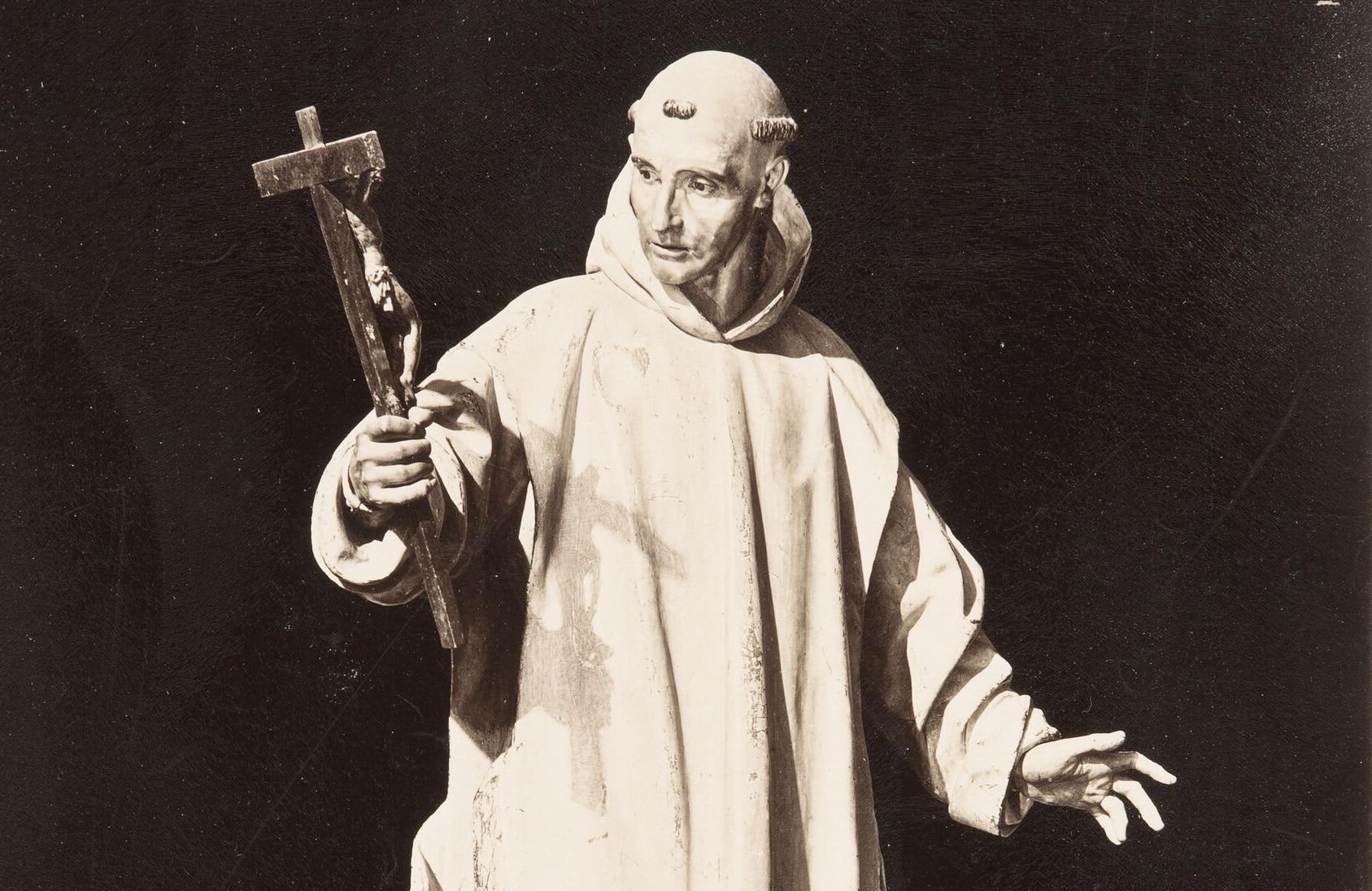
Image: Statue of St. Bruno by an anonymous artist, photographed by Jenny Bergensten